This article contains affiliate links. We may earn a commission from qualifying purchases.
Some content on this site is AI-assisted and reviewed by our editorial team.
For two years, I kept my dog’s food in the original bag, folded shut, in the pantry. I thought I was being practical. The bag is designed to hold food, right? Why buy a container when the bag already does the job?

Then I noticed my dog’s food was going stale about three weeks into each bag. She started eating less, and the kibble smelled off. I also found pantry moths in the bag — tiny brown bugs that had chewed through the paper. I threw away 15 dollars worth of food and bought a container the same day.
It turns out that dog food bags are designed for shipping, not storage. Once you open the bag, oxygen, moisture, and pests start degrading the food immediately. The fats in dog food go rancid within 3 to 4 weeks of exposure to air. That’s not a food quality issue — it’s a health issue. Rancid fats can cause digestive problems and refuse to eat. A 15-dollar container pays for itself in saved food within two months.
I tried four containers. Here’s what I found.
IRIS Airtight Pet Food Container — The One I Use Now
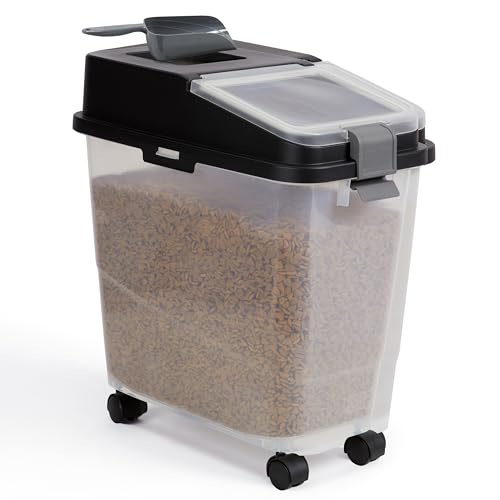
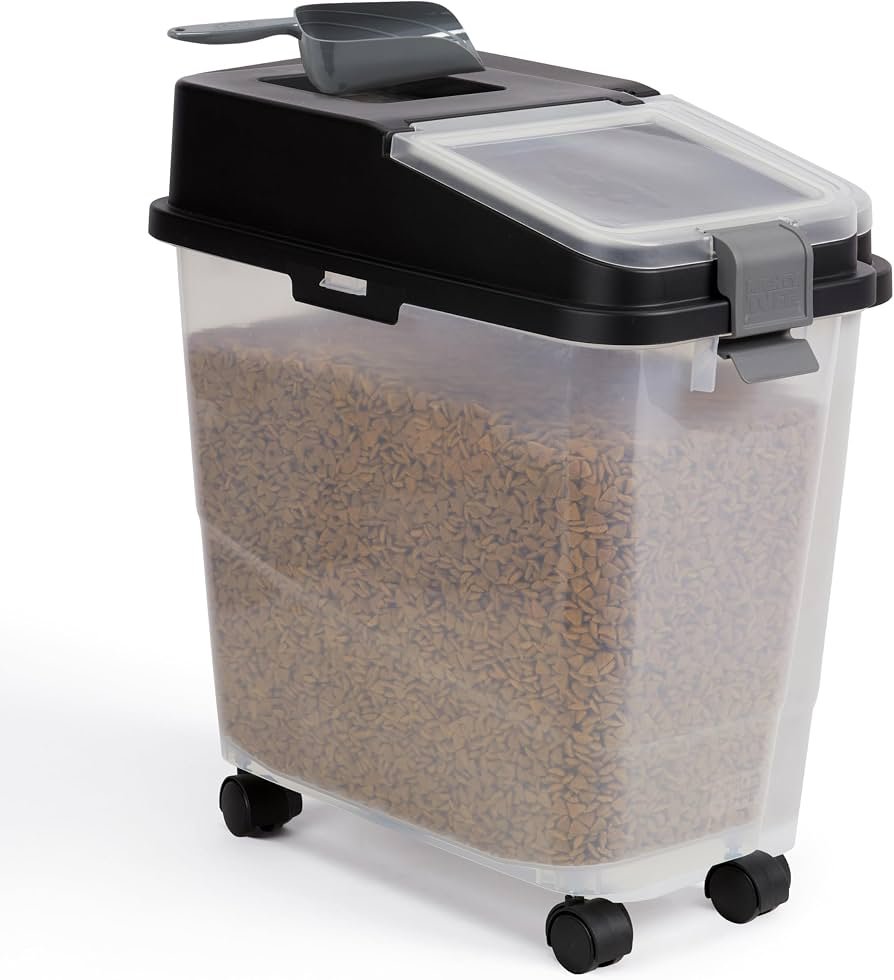
The IRIS Airtight Container holds about 25 pounds of kibble, which is exactly one large bag. It has a snap-tight lid with a gasket that creates an actual airtight seal — not just a lid that closes, but a lid that seals. I tested this by putting food in it and leaving it in the garage during a humid week. No moisture got in. The food was as fresh on day 21 as on day 1.
The container is translucent enough to see how much food is left without opening it, which is convenient — no more guessing whether I need to buy more. The wide mouth makes it easy to pour a full bag in without spilling. It’s also small enough to fit in my pantry next to the cereal.
At about 22 dollars, this is the sweet spot of price and quality. I’ve been using mine for 8 months with no issues. The seal still works perfectly, and it’s been dropped twice without cracking.
My take: This is the one to buy. Holds one full large bag, actually seals airtight, and costs less than two bags of food. No reason to overthink this.
Vremi Large Pet Food Container — The Budget Option
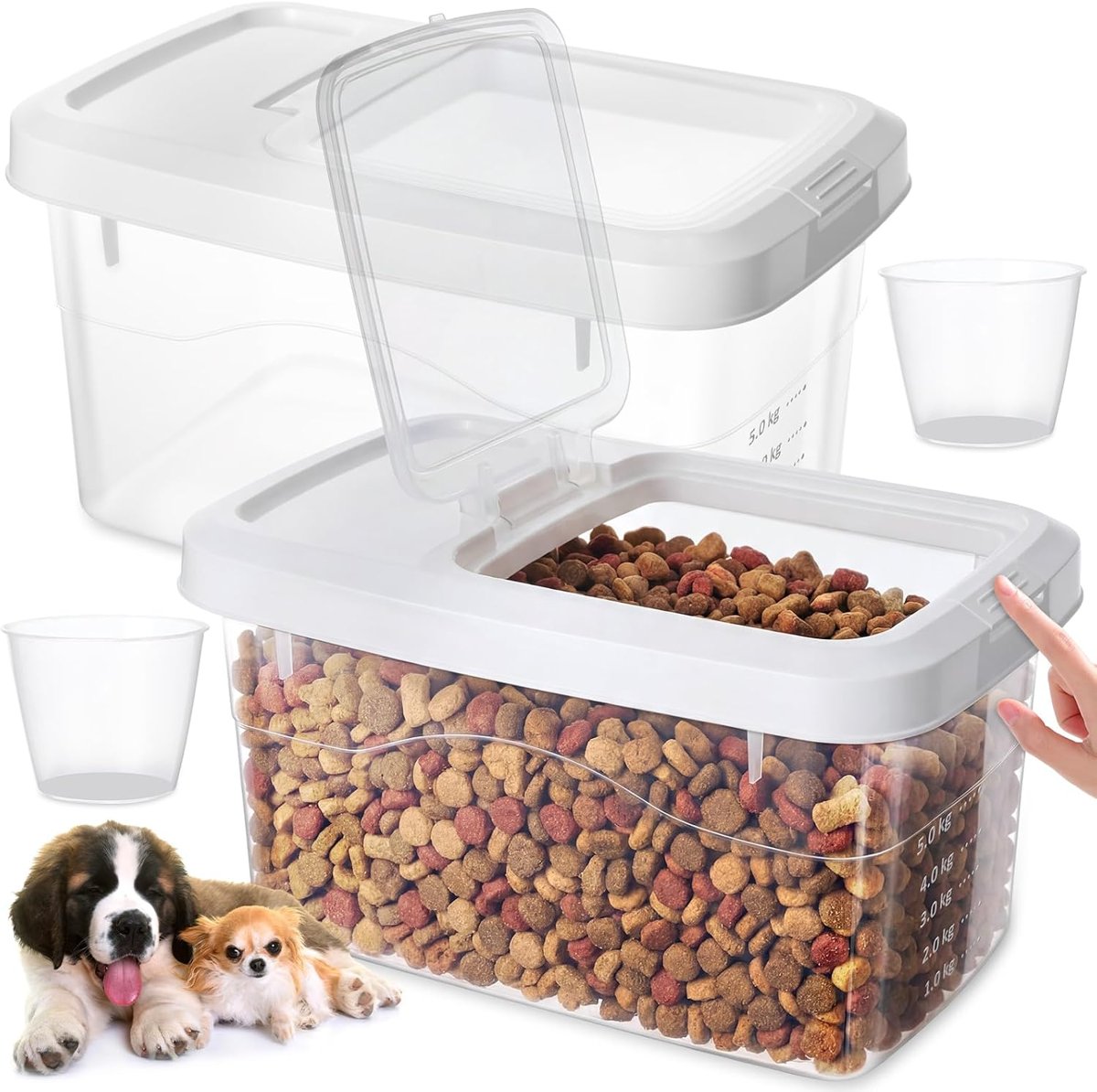
The Vremi container is similar in capacity (holds about 25 pounds) but costs about 18 dollars. The lid snaps shut but doesn’t have a rubber gasket — it relies on the plastic-on-plastic friction fit for a seal. It’s better than an open bag, but it’s not truly airtight. Humid air will eventually get in.
I used this for about a month before upgrading to the IRIS. It kept food fresh for about 2 weeks — fine if you go through a bag of food quickly, but not great if a bag lasts you 4+ weeks like mine does. The container itself is sturdy and well-built. The lid just doesn’t seal as tightly as I wanted.
My take: Fine for small dogs where a bag of food lasts 1 to 2 weeks. If your food lasts longer, spend the extra 4 dollars on the IRIS with the gasket seal.
Stackable Storage Bins — Good for Multi-Pet Households
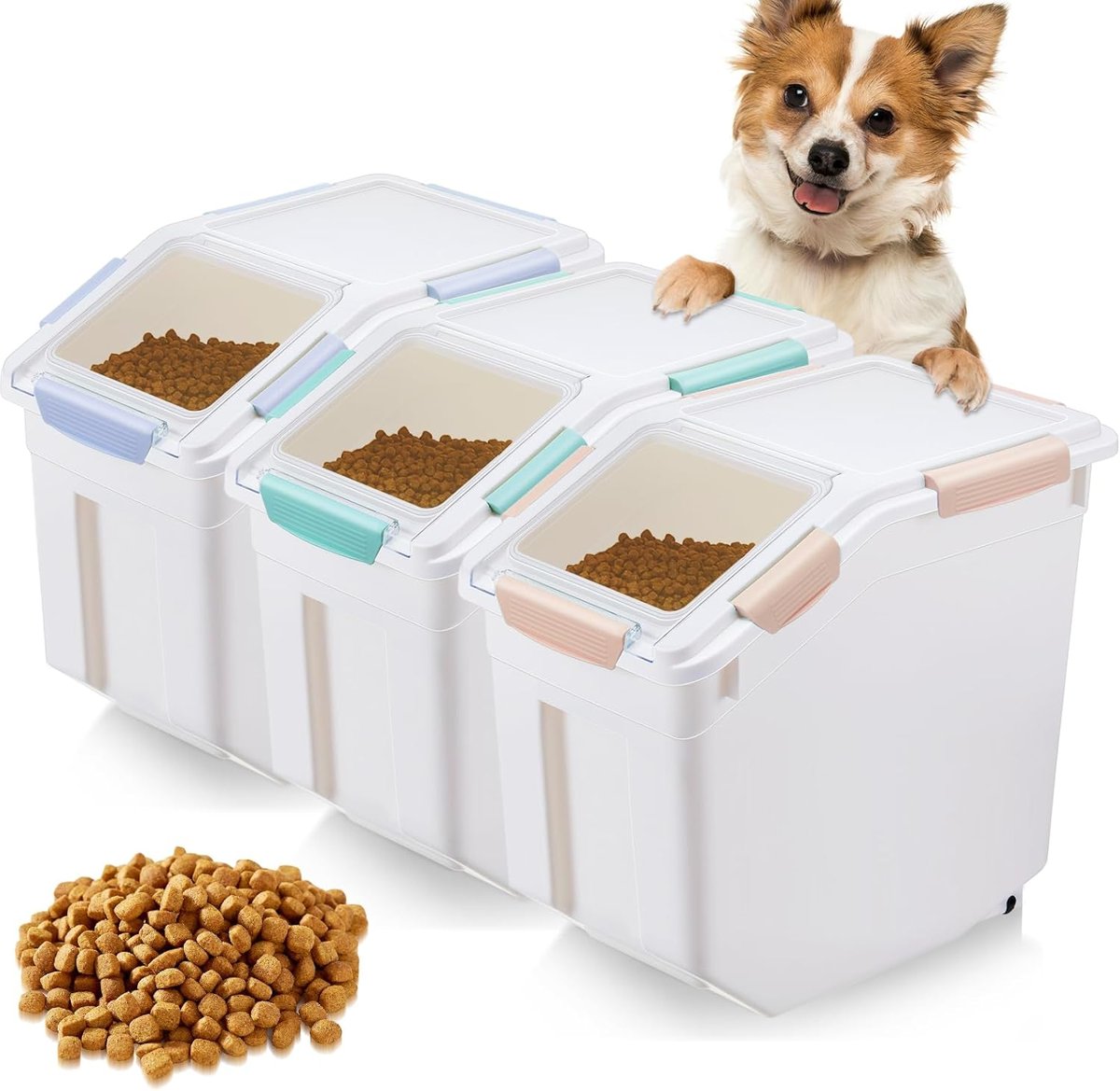
These stackable bins are designed for households with multiple pets — one bin for dog food, one for cat food, one for treats. Each bin holds about 15 pounds, and they stack to save floor space.
I don’t have multiple pets (yet), so I can’t speak to the multi-pet use case. But for a single large dog, 15 pounds per bin means refilling every 10 days, which is more frequent than I want. The stacking mechanism is sturdy, and the bins have wheels on the bottom for easy pulling out of a pantry.
A set of two costs about 30 dollars. That’s 15 dollars per bin — competitive with the Vremi. But for one dog, a single 25-pound container is simpler and requires fewer refills.
My take: If you have a dog and a cat, or you want to separate food from treats, these make sense. For a single-dog household, a single larger container is simpler.
What I’d Skip: The Food Dispenser
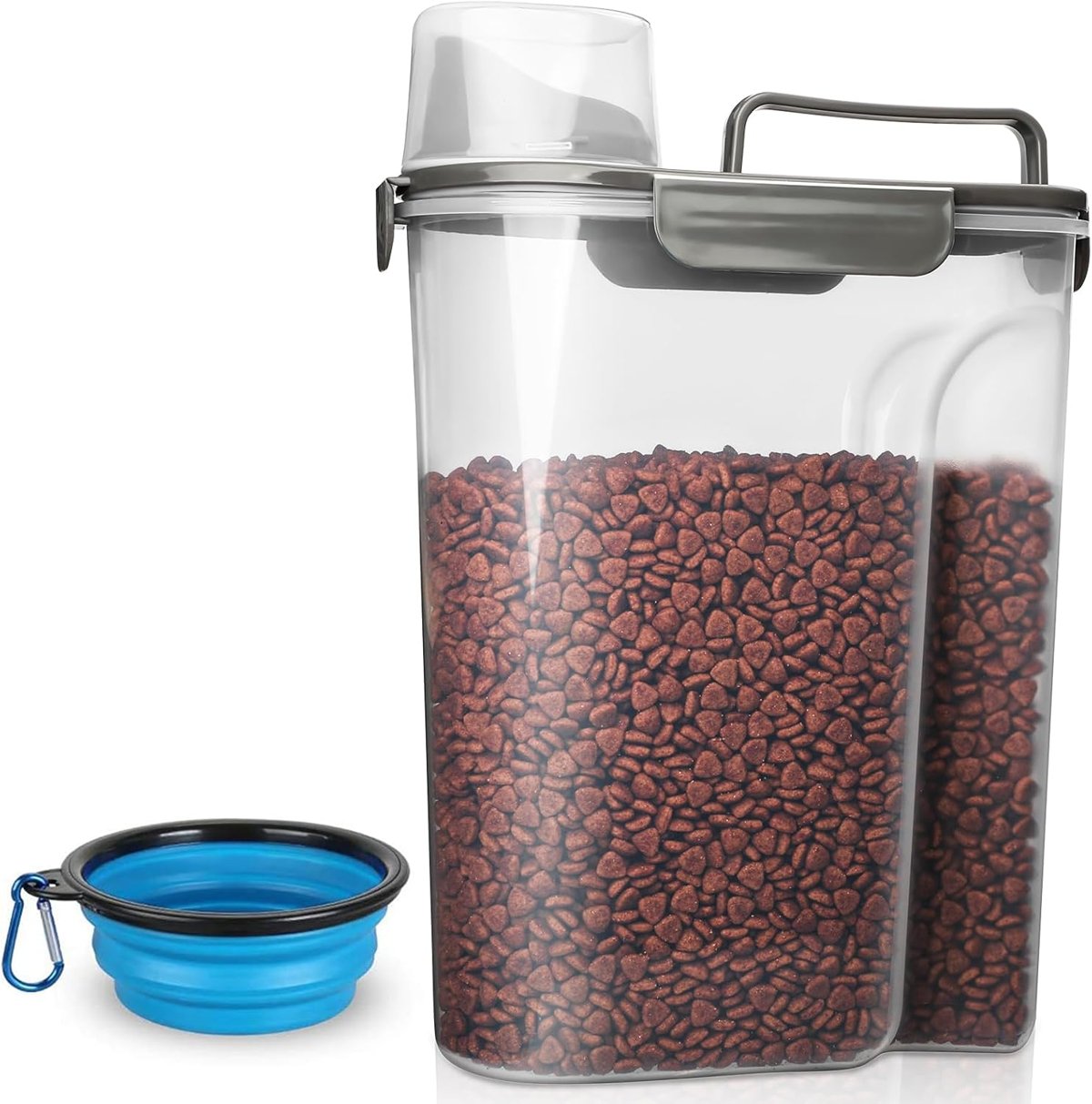
The gravity-fed dispenser looks clever — you press a lever and food pours into a bowl. No measuring cup needed. But the dispensing mechanism is where food gets stuck, and that’s where moisture and old kibble accumulate and mold. I tried one and found old food clogging the mechanism within a month.
Cleaning the dispenser mechanism requires taking it apart, which is fiddly and time-consuming. The simplicity of a container with a lid — scoop, pour, close — is better than a dispenser that adds a cleaning chore. Stick with a plain airtight container and use a measuring cup.
My take: Looks smart, creates more problems than it solves. Get a simple container and a measuring scoop.
Get food storage delivered fast. Start your 30-day Prime free trial for free 2-day shipping on containers and more.
The Real Cost of Not Using a Container
Here’s the math that convinced me to spend 22 dollars on a container:
- One 30-pound bag of mid-range kibble: about 55 dollars
- Food going stale at week 3, dog eating 25 percent less: 14 dollars wasted per bag
- Pantry moth infestation requiring disposal of remaining food: 20 to 30 dollars lost
- Total waste per bag without a container: 14 to 30 dollars
- Cost of the IRIS container: 22 dollars
The container paid for itself in the first month. Every month after that, I’m saving 15 to 30 dollars in wasted food. Over a year, that’s 180 to 360 dollars — enough to upgrade my dog’s food to a better brand.
A few tips I learned along the way:
- Keep the food in the original bag inside the container. The bag has a fat barrier coating that the container doesn’t. Double protection.
- Don’t wash the container with soap and water between bags — moisture gets trapped. Wipe it out with a dry paper towel instead.
- Write the expiration date from the bag on the container with a dry-erase marker. You’ll always know how fresh the food is.
- Store the container in a cool, dry place. Heat accelerates fat breakdown even in an airtight container.
For more on feeding on a budget, check our guide to puppy food on a budget and our review of budget crates for large dogs.
ThriftyPaw is reader-supported. As an Amazon Associate, I earn from qualifying purchases. That means if you buy through one of the links above, I get a small commission at no extra cost to you. I only recommend products I’ve actually used in my own kitchen.
Related guides
- Cat Dental Disease on a Budget: Complete Prevention Guide Under 8 Dollars Per Month
- Flea & Tick Prevention: What Actually Works and What's a Waste of Money
- How Much Should You Feed a German Shepherd? Real Portions, Real Costs
- Cat Skin Problems on a Budget: Complete Guide to 8 Common Causes Under 15 Dollars
- Budget-Friendly Dog Dental Cleaning: Professional vs DIY Guide (2026)
🐾 Get Your Free Big Dog First Aid Kit Checklist
Join our newsletter and get this free printable plus weekly tips.
Frequently Asked Questions
Is it bad to keep dog food in the bag?
The author's two-year answer: stale food by week three, pantry moths chewing through the paper, and $15 of kibble thrown away — the rolled-up bag is designed to hold food in a factory, not to seal it in a pantry. The $15-22 container pays for itself in saved food within two months; the annual waste math runs $180-360.
What's the best dog food container?
The IRIS airtight at $22 — the author's kept pick with the gasket seal for longer-lasting food; the Vremi at $18 for the budget tier if bags finish fast; and the stackable bins at $30 for two ($15 each) for multi-pet households. Skip the dispenser: it's the one the author explicitly flags as not worth it.
Why does my dog's food go stale?
Fat oxidation — the moment the bag opens, air starts turning the fats rancid, and the three-week mark is where the author noticed the smell and the reduced eating. The container's job is stopping that clock; the cool-dark-spot storage does the other half (heat and light accelerate the same oxidation).
Liked this guide? Get the next one in your inbox — the pet budget checklist is free too.
✓ You're in — check your inbox.
No spam. Unsubscribe anytime. We never share your email.
Price Check
Prices verified via our product tracker. Updated Sep 27.
| Pet Supplies : Acellegic 2 Pack 11 Lbs Airtight Dog Food S | $41.99 | 3.0★ |
| TIOVERY Dog Food Storage Container, 5-7 Lbs Airtight Pet F | $22.99 | 4.4★ (4,642) |
| Mighty Tuff Airtight Dog Food Storage Container, Up to 36 | $51.82 | 3.3★ (166) |
As an Amazon Associate we earn from qualifying purchases.