This article contains affiliate links. We may earn a commission from qualifying purchases.
Some content on this site is AI-assisted and reviewed by our editorial team.
Dog sunscreen is not a gimmick. Dogs get sunburn, and sunburn leads to skin cancer. Short-coated breeds, light-colored dogs, and dogs with thin fur on their belly or nose are at highest risk. A dog with a sunburned nose is miserable, and nose sunburn can progress to squamous cell carcinoma, a serious skin cancer. The good news: sun protection for dogs costs under 15 dollars and takes 2 minutes to apply. This guide covers which dogs need sunscreen, what products are safe, and how to protect your dog from UV damage on a budget.

Which Dogs Need Sunscreen?
Not all dogs need sunscreen. Dogs with thick, dark coats are naturally protected. But these dogs are at high risk:
- Short-coated breeds — Pit Bulls, Boxers, Dalmatians, Greyhounds, Whippets, Bulldogs, French Bulldogs. Their fur is too thin to block UV.
- Light-colored or white dogs — light fur provides less UV protection than dark fur.
- Dogs with pink or light noses — the nose is the most common sunburn site. Pink-nosed dogs have less natural pigment protection.
- Dogs with thin belly fur — sunlight reflects off pavement and water, hitting the belly where fur is thinnest.
- Dogs that lie in the sun — even thick-coated dogs can sunburn on the belly if they sunbathe on their back.
- Dogs at high altitude or near water — UV intensity increases 4-5 percent per 1,000 feet of elevation. Water and sand reflect 80 percent of UV rays, doubling exposure.
- Recently shaved dogs — if your dog was shaved for surgery or grooming, the exposed skin has no fur protection.
Signs of Sunburn in Dogs
- Red, warm skin (especially on the nose, belly, ear tips, and around the eyes)
- Dog scratching or licking at irritated areas
- Peeling or flaking skin
- Blisters (severe burns)
- Crusting or scabs on the nose or ear tips
Sunburn is uncomfortable in the short term and can cause skin cancer with repeated exposure. Squamous cell carcinoma in dogs appears as raised, crusty lesions on the nose, ear tips, or belly. Treatment involves surgical removal (500-1,500 dollars) or radiation therapy (3,000-5,000 dollars). Prevention costs 10-15 dollars.
Can You Use Human Sunscreen on Dogs?
No — most human sunscreens are toxic to dogs. Dogs lick their skin, and ingesting human sunscreen ingredients can cause serious toxicity.
Toxic Ingredients in Human Sunscreen
- Zinc oxide — the most common active ingredient in human sunscreens. Toxic to dogs if ingested. Causes vomiting, diarrhea, and red blood cell damage.
- Octinoxate, oxybenzone, avobenzone — chemical UV filters that can cause gastrointestinal upset and skin irritation in dogs.
- Fragrances and alcohols — irritate canine skin, which is more sensitive than human skin.
What to Look For in Dog Sunscreen
- Specifically formulated for dogs — the label should say “pet safe” or “dog sunscreen.”
- No zinc oxide — check the active ingredients. Pet-safe sunscreens use alternatives like titanium dioxide (non-toxic if ingested in small amounts).
- SPF 15-30 — dogs do not need SPF 50+. SPF 15-30 provides adequate protection for most situations.
- Fragrance-free — fragrances irritate canine skin.
- Water-resistant — dogs swim and sweat through their paws. Water resistance lasts longer.
- Non-greasy — greasy residue transfers to furniture and attracts dirt.
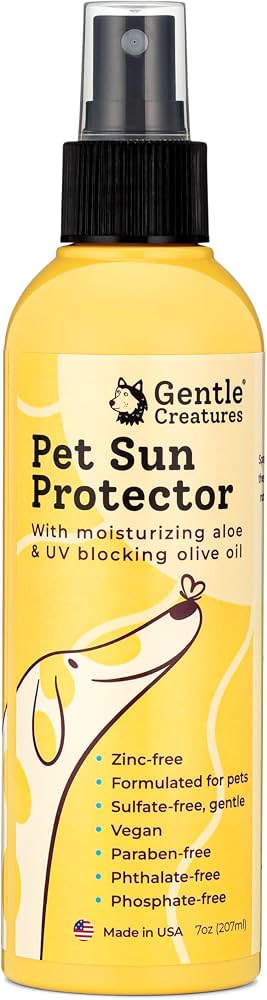
Budget Dog Sunscreen Products (All Under 15 Dollars)
| Product | Price | SPF | Size |
|---|---|---|---|
| Epi-Pet Sun Protector | 12-15 dollars | SPF 30+ | 4 oz spray |
| Petkin Dog Sunscreen | 8-12 dollars | SPF 15 | 2 oz stick |
| Bodhi Dog Sun Balm | 10-14 dollars | SPF 30 | 2 oz balm (nose/ears) |
Best value: Epi-Pet Sun Protector — the only dog sunscreen with FDA approval. It is a spray that covers large areas (belly, back) easily. One bottle lasts a summer with daily use for a medium dog.
Best for nose/ears: Bodhi Dog Sun Balm — a thick balm that stays on the nose and ear tips where sunburn is most common. Does not drip or rub off. A small tin lasts months.
Free Sun Protection Strategies
1. Shade (Free)
The simplest sun protection is shade. When the sun is most intense (10 AM to 4 PM), keep your dog in shade. If you are at the beach, park, or backyard, bring a pop-up shade tent or use a natural shade source (tree, building). A beach umbrella (15-25 dollars) works for both you and your dog.
2. Timing (Free)
Walk before 8 AM and after 6 PM during summer. UV index is highest between 10 AM and 4 PM. Early morning and evening walks have UV indexes under 3, which is safe for most dogs without sunscreen.
3. Dog Clothing (8-20 Dollars)
A lightweight sun shirt blocks UV without needing sunscreen on the covered areas. Look for:
- UPF 50+ rating (UV protection factor for fabric)
- Lightweight, breathable material (not heavy cotton)
- Coverage of the belly (most sun shirts only cover the back — look for wrap-style shirts)
Budget options: Kurgo Surf N Turf (25-35 dollars, doubles as a life jacket), or a plain UPF rash guard from Amazon (8-15 dollars) in your dog’s size.
4. Avoid Shaving Your Dog (Free)
Many owners shave their double-coated dogs in summer, thinking it keeps them cool. This is a myth — double coats provide insulation against heat as well as cold. Shaving exposes the skin to UV rays, increasing sunburn and skin cancer risk. If your dog’s coat is matted, have it professionally groomed and thinned, not shaved to the skin.
How to Apply Dog Sunscreen
- Apply 15 minutes before sun exposure — allows the sunscreen to bond with the skin.
- Focus on high-risk areas — nose, ear tips, belly, around the eyes, and any areas with thin or no fur.
- Apply generously — a thin layer is not effective. Use enough to create a visible white layer that rubs in.
- Reapply every 2 hours — or after swimming, even if the product is water-resistant.
- Test on a small area first — apply a small amount to the belly and wait 24 hours. If no irritation occurs, use full-body.
The Bottom Line
Dog sunscreen costs 10-15 dollars and prevents sunburn that can lead to skin cancer costing 500-5,000 dollars. Short-coated, light-colored, and pink-nosed dogs need it most. Use a pet-specific sunscreen (never human sunscreen — zinc oxide is toxic). Epi-Pet Sun Protector (12-15 dollars) is the best overall value. For nose and ear tips, use Bodhi Dog Sun Balm (10-14 dollars). Combine sunscreen with free strategies: walk before 8 AM and after 6 PM, use shade, avoid shaving double-coated breeds, and consider a UPF 50+ sun shirt for all-day protection. Two minutes of application prevents weeks of discomfort and thousands in vet bills.
Last updated: July 2026 | By ThriftyPaw | Prices and availability subject to change
ThriftyPaw is reader-supported. As an Amazon Associate, we earn from qualifying purchases. This means we may earn a small commission when you buy through links on this site at no additional cost to you. We only recommend products we genuinely believe in. Thank you for supporting ThriftyPaw.
My take: This is a $12 problem with a five-figure downside — the Epi-Pet spray plus the nose balm covers the risk zones, and shade-and-timing does the daily work. The only wrong answers are human sunscreen and nothing at all.
Related guides
- Budget Dog Backpacks for Hiking: Complete Guide Under 35 Dollars (2026)
- Best Budget Dog Jackets and Cold Weather Gear (Under 30 Dollars — 2026)
- Dog Poisoning Prevention: A Budget Guide to Household Toxins (2026)
- Orthopedic Dog Beds Under $50 That Actually Support Big Dogs
- The Real Cost of Owning a Dog in 2026 — and How to Cut It in Half
🐾 Get Your Free Big Dog First Aid Kit Checklist
Join our newsletter and get this free printable plus weekly tips.
Frequently Asked Questions
Do dogs really get sunburned?
Yes — and it's the same progression as in humans: repeated burns lead to skin cancer, specifically squamous cell carcinoma on the nose and ears. Short-coated, light-colored, and pink-nosed dogs are highest risk. The guide's cost framing is the argument: $10-15 prevention against $500-1,500 surgical removal or $3,000-5,000 radiation.
How do I protect my dog from the sun for free?
Shade and timing — walks before mid-morning and after late afternoon, and natural or umbrella shade ($15-25 for one that covers dog and owner both). The sun shirt at $8-20 with UPF 50+ is the cheap gear layer for dogs that tolerate it, and it eliminates the reapplication problem on covered areas.
What should I look for in a dog sunscreen?
Lick-safe formulation for dogs (the Epi-Pet at $12-15, SPF 30+ spray; the Petkin stick at $8-12; the Bodhi balm for noses at $10-14), no zinc oxide or PABA, and the right format for the zone — sprays for bodies, sticks and balms for noses and ears. Reapply every 2 hours in continuous sun.
Liked this guide? Get the next one in your inbox — the pet budget checklist is free too.
✓ You're in — check your inbox.
No spam. Unsubscribe anytime. We never share your email.
Price Check
Prices verified via our product tracker. Updated Sep 27.
| Epi-Pet K-9 Care Sunscreen, Paws to Tail Protection, Preve | $35.00 | 4.2★ |
| Petkin Dog Sunscreen Sunstick – Sunscreen for Dogs and Pup | $11.95 | 4.4★ (1,079) |
| Bodhi Dog Sunscreen SPF 30+ Moisturizing Pet Sun Spray - S | $17.99 | 4.4★ (2,444) |
As an Amazon Associate we earn from qualifying purchases.