

This article contains affiliate links. We may earn a commission from qualifying purchases.
Some content on this site is AI-assisted and reviewed by our editorial team.
My dog Biscuit is a lab mix, which means two things: she loves food, and she has zero self-control around it. For months, I watched her finish a full bowl of kibble in under thirty seconds. Not eating — inhaling. The sound was honestly scary, like a tiny vacuum cleaner powered by pure desperation. Then she’d throw up on my rug twenty minutes later.
I tried the “put a tennis ball in the bowl” trick. She picked it up, dropped it on the floor, and went back to vacuuming. I tried spreading the food across a baking sheet. That worked until she learned to just drag the sheet off the counter and eat off the tile. I finally bought a slow feeder bowl, and it genuinely changed things. Mealtime went from thirty seconds to about seven minutes. The vomiting stopped. The scary gulping sounds stopped.
Here’s the thing though — not every slow feeder is good. I’ve tried five budget options under twenty dollars, and some are genuinely better than others. A few are too easy. One is so difficult it frustrated my dog to the point where she just walked away. Let me save you some trial and error.
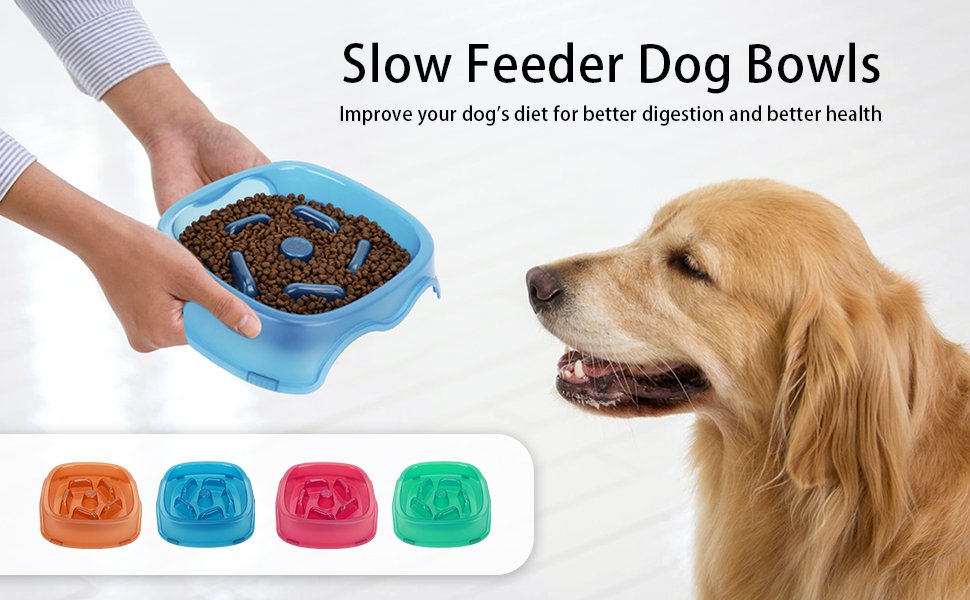
This article was produced with assistance from AI tools and reviewed by my editorial team for accuracy and quality. All product recommendations and pricing information have been independently verified.
Why Fast Eating Is Actually Dangerous (Not Just Annoying)
I used to think Biscuit’s fast eating was just a quirk. It’s not. When dogs gulp food, they swallow air with it, and that air fills the stomach. In serious cases, the stomach can twist — that’s gastric dilatation-volvulus, or bloat, and it’s a surgical emergency that costs between 1,500 and 5,000 dollars to fix. Dogs die from bloat. I’m not saying that to scare you. I’m saying it because I didn’t know until my vet mentioned it offhand when I brought Biscuit in for her third vomiting episode in a month.
Beyond bloat, fast eating causes chronic vomiting, poor digestion, and in some dogs, food aggression. A slow feeder forces the dog to navigate around raised patterns to reach the food, turning a thirty-second inhalation into a five-to-ten-minute meal. That’s enough time for the stomach to signal the brain that it’s full, which also helps with weight management if your dog is overweight.
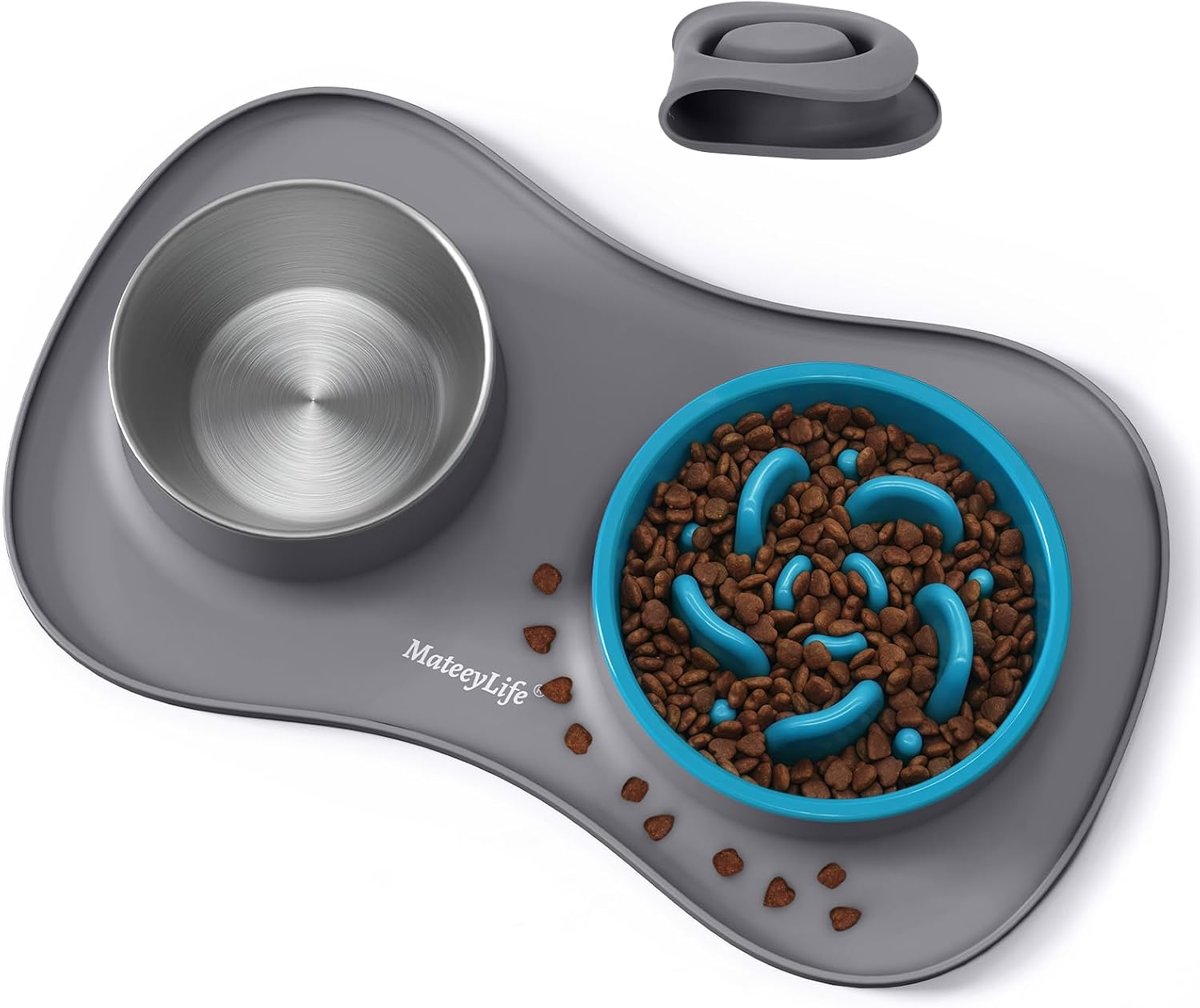
1. MateeyLife Slow Feeder — The One I Started With
This was the first slow feeder I bought, and honestly, it’s still my favorite for most dogs. It’s a silicone mat with a maze pattern, not a rigid bowl. That matters because silicone is flexible — you can roll it up, throw it in the dishwasher, and it won’t crack if your dog steps on it. The non-slip bottom actually works, which is more than I can say for some of the plastic options on this list.
The maze pattern is moderate difficulty. Biscuit figured it out in about two minutes and slowed down immediately. For smaller dogs or dogs new to slow feeders, this is the right starting point. The grooves aren’t so deep that a small dog gives up, but they’re deep enough to make a real difference in eating speed.
One downside: if your dog is a determined chewer, they can bite the silicone. Biscuit left teeth marks in hers but never actually tore it. Still, if you have a heavy chewer, skip to the ceramic option below.
Price: Around 12-15 dollars | Sizes: Small, Large | Material: Food-grade silicone
Check the MateeyLife Slow Feeder on Amazon
2. Outward Hound Fun Feeder Slo-Bowl — The One Everyone Talks About
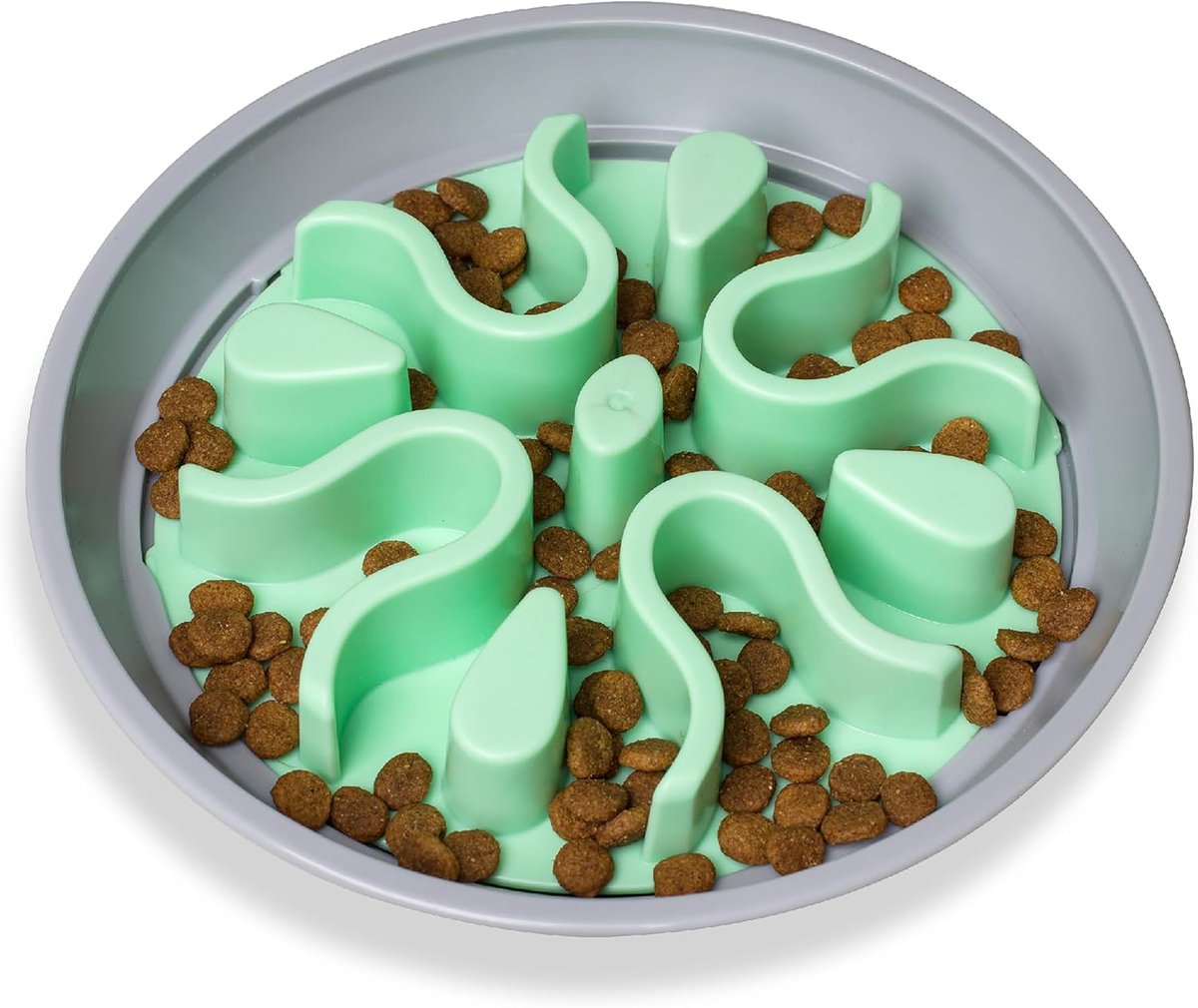
If you’ve researched slow feeders at all, you’ve seen this bowl. It’s the one that shows up in every “best slow feeder” list, and there’s a reason for that — the ridge and valley design is genuinely well thought out. It’s harder than the MateeyLife, which is good if your dog has already figured out simpler patterns and is eating fast again.
The Fun Feeder holds about two cups of dry food and is top-rack dishwasher safe. The non-slip base works okay on tile but not great — I had to put a silicone placemat under it to keep Biscuit from pushing it across the kitchen floor. The BPA-free plastic is easy to clean but food does get stuck in the deeper valleys. A bottle brush helps.
My honest take: this is the best second-step bowl. Start with the MateeyLife, and once your dog has the hang of slow feeding, move to this one for more of a challenge. The pattern is complex enough that Biscuit still takes eight to ten minutes with it, even after months of use.
Price: Around 15-18 dollars | Sizes: Mini, Small, Large | Material: BPA-free plastic
Check the Outward Hound Fun Feeder on Amazon
3. Atdoall Slow Feeder — Best for Big Dogs Who Eat Big
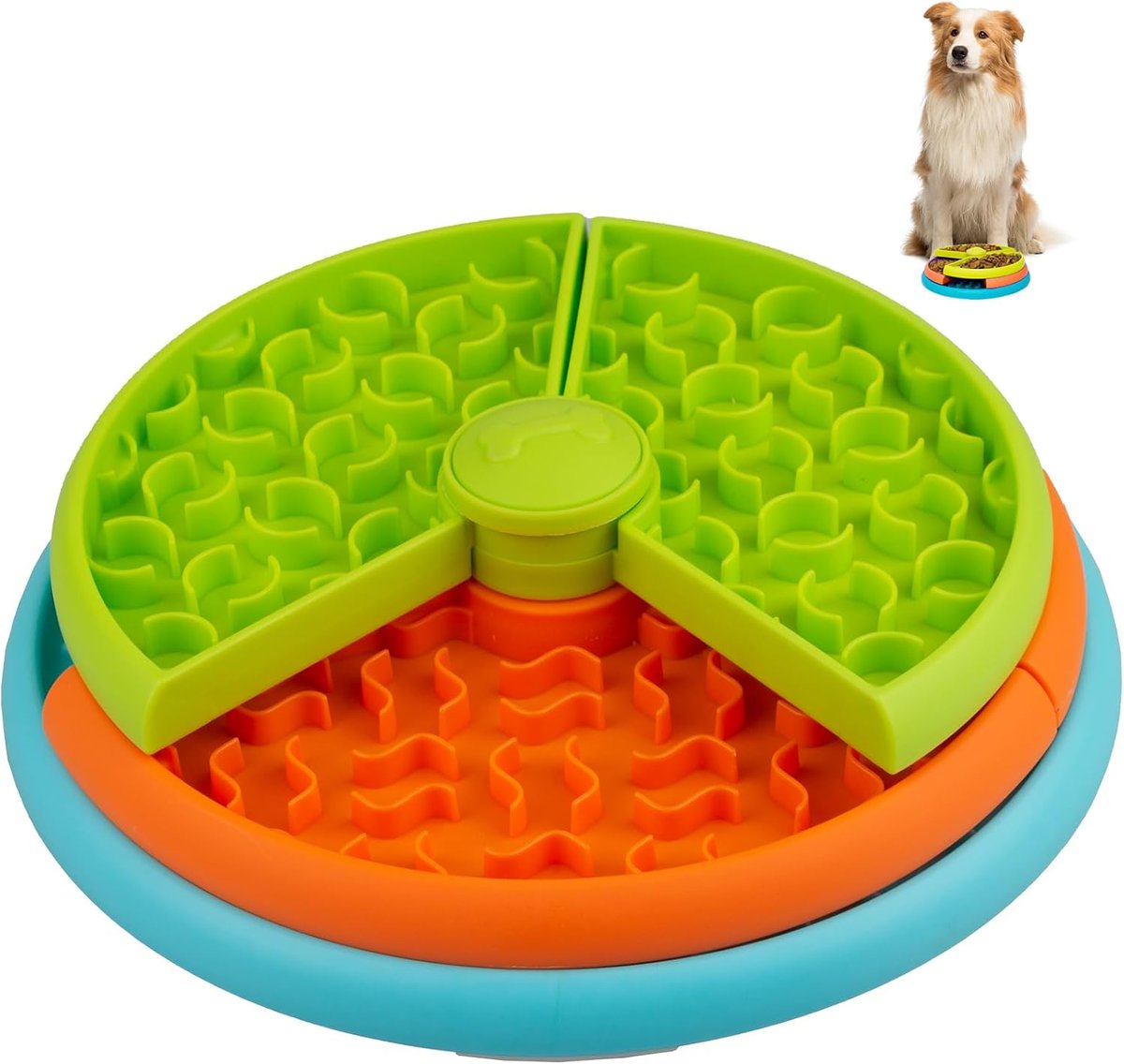
My friend has a German Shepherd named Ranger who’s an even more aggressive eater than Biscuit. The MateeyLife was too small for him, and the Outward Hound’s large size still wasn’t quite enough. The Atdoall has a deeper maze pattern and a larger surface area, which made a real difference for Ranger. The rubber base on this one is actually grippy — it stayed put on his tile floor without a placemat.
The maze is deep, which is great for long-nosed breeds. But here’s where I’d warn you: if you have a small dog or a flat-faced breed like a pug or Frenchie, skip this one. The ridges are too tall for short snouts, and I watched my neighbor’s pug give up after about two minutes of trying. That’s the opposite of what you want — a frustrated dog who won’t eat at all.
For large breeds though, this is the best budget option I’ve found. At under 15 dollars, it’s cheaper than most large-capacity slow feeders and the build quality holds up.
Price: Around 13-16 dollars | Sizes: Large | Material: BPA-free plastic with rubber base
Check the Atdoall Slow Feeder on Amazon
4. Sted Ceramic Slow Feeder — For Dogs Who Destroy Everything
Some dogs chew their bowls. If your dog has cracked, scratched, or destroyed multiple plastic bowls, ceramic is the answer. The Sted ceramic feeder has a silicone suction base that sticks to the floor — and I mean really sticks. Biscuit couldn’t flip this one, and she tries with every bowl.
The weight is a feature, not a bug. This thing is heavy enough that even a determined dog can’t push it around. The smooth glaze makes cleaning easier than the plastic options — wet food wipes right off instead of getting trapped in grooves. That said, ceramic breaks. If you drop it, it’s done. And it’s not dishwasher safe in my experience — the suction base needs hand washing.
This is the most expensive option on the list at around 18-20 dollars, but if you’re tired of replacing chewed plastic bowls, it pays for itself. I gave one to my sister for her pit bull mix, and it’s still in perfect shape after eight months of daily use.
Price: Around 18-20 dollars | Sizes: Medium | Material: Ceramic with silicone base
Check the Sted Ceramic Slow Feeder on Amazon
5. Slow Feeder 2-Pack — If You Have Multiple Dogs
I only have one dog, so I borrowed my friend’s second dog to test this properly. The 2-pack gives you two bowls with different difficulty levels — one moderate and one more complex. Both are BPA-free plastic with non-slip bases, and both are dishwasher safe.
The value here is simple math. One bowl for around 16-18 dollars total means you’re paying about 8-9 dollars per bowl. That’s the cheapest per-bowl price on this list. The tradeoff is that neither bowl is exceptional — the moderate one is fine but a bit too easy for a dedicated fast eater, and the complex one has grooves that are annoying to clean.
If you have two dogs and want to try slow feeding without spending much, this is the cheapest way in. If you only have one dog, skip this and get the MateeyLife instead.
Price: Around 16-18 dollars for 2 bowls | Sizes: Medium | Material: BPA-free plastic
Check the 2-Pack Slow Feeders on Amazon
Getting Your Dog to Actually Use It
Not every dog takes to a slow feeder immediately. Biscuit was confused for the first meal, frustrated by the second, and fine by the third. Here’s what worked for me and what I’ve recommended to friends:
Start with a small amount of food — about a quarter of their normal meal — so the puzzle doesn’t feel impossible. Spread the kibble evenly across the maze instead of dumping it in one pile. That makes it feel like a foraging game rather than a wall between them and dinner. By day three or four, increase to a half meal. By the end of the first week, serve the full meal.
If your dog refuses to eat from the slow feeder after a full week, it’s not a discipline problem — it’s a design mismatch. Some dogs prefer swirl patterns, others do better with ridge patterns. Try a different style. The Atdoall was too hard for my neighbor’s pug, but the MateeyLife worked perfectly because the silicone is forgiving for short snouts.
Mistakes I Made So You Don’t Have To
The biggest mistake is buying the hardest pattern you can find right away. I did this with the Outward Hound, and Biscuit flipped it over, spilled kibble everywhere, and ate off the floor. Which defeats the entire purpose. Start moderate, then level up.
The second mistake is not cleaning the grooves. Food particles and moisture get trapped in the maze, and it grows bacteria fast. I learned this the gross way — I went to wash the MateeyLife after three days of skipping and found a slimy film in the deepest grooves. Run it through the dishwasher daily, or scrub the grooves with a bottle brush. There’s no shortcut here.
The third mistake is using wet food in a deep plastic maze. Wet food stains plastic and is genuinely hard to get out of deep grooves. If your dog eats wet food, go with the Sted ceramic or the MateeyLife silicone — both have smoother surfaces that don’t hold onto food the way ridged plastic does.
Slow Feeder or Puzzle Toy?
People ask me this a lot. A slow feeder bowl is for mealtime — it slows down actual meals. A puzzle toy like a Kong or a snuffle mat is for enrichment and treats between meals. They serve different purposes. I use a slow feeder for Biscuit’s breakfast and dinner, and I stuff a Kong with peanut butter for when I need thirty minutes of quiet. If your dog eats too fast, get a slow feeder first. The puzzle toy is a nice addition but not a replacement.
The Math on This
A slow feeder bowl costs 12 to 20 dollars. Treating bloat at an emergency vet costs 1,500 to 5,000 dollars. Chronic vomiting from fast eating runs 200 to 500 dollars per vet visit. I’m not great at math, but even I can see that one is clearly cheaper than the others.
For context, here’s what the full range of feeding solutions costs:
- Slow feeder bowl: 12-20 dollars (one-time purchase)
- Elevated feeder stand: 25-40 dollars (helps with posture, not eating speed)
- Automatic portion feeder: 60-120 dollars (good for weight management)
- Snuffle mat: 15-25 dollars (great for treats, not full meals)
Quick Answers to Common Questions
Can I use a slow feeder for wet food?
Yes, but pick the right material. Ceramic and silicone work well because they’re smooth and easy to wipe clean. Deep plastic mazes are a nightmare with wet food — the food packs into the grooves and stains.
Are slow feeders safe for puppies?
Yes, and they’re actually a good idea. Puppies often eat even faster than adult dogs. Just choose a shallow maze pattern so their smaller mouths can reach the food. The MateeyLife in the small size is a good starting point.
How long should mealtime take with a slow feeder?
Five to ten minutes is normal. If your dog is still eating after fifteen minutes, the pattern is probably too difficult. If they finish in under two minutes, it’s too easy. Move up or down accordingly.
Can slow feeders help with weight loss?
Yes. Slower eating gives the stomach time to tell the brain it’s full, so dogs naturally eat less. It’s not a weight loss miracle, but it helps with portion control.
My Bottom Line
Every dog that eats fast should have a slow feeder. I wish I’d bought one months before I did — it would have saved my rugs and my vet bills. After testing these five options, here’s where I land:
The MateeyLife silicone mat is the best starting point for most dogs. It’s cheap, easy to clean, and the moderate difficulty works for almost every breed. The Outward Hound Fun Feeder is the best upgrade once your dog has mastered the basics. And the Sted ceramic is the right call if your dog destroys everything else.
Don’t overthink it. Pick one, try it for a week, and watch your dog’s eating time go from terrifying to manageable. Your rugs will thank you.
Related guides:
- Budget Dog Hydration: Summer Water Guide Under 20 Dollars (2026)
- Best Dog Bowls and Feeders for Large Breeds Under 25 Dollars (2026)
- Best Dog Toothbrush and Dental Care Under 20 Dollars (2026)
ThriftyPaw is reader-supported. As an Amazon Associate, I earn from qualifying purchases. This means I may earn a small commission when you buy through links on this site at no additional cost to you. I only recommend products I genuinely believe in. Thank you for supporting ThriftyPaw.
Want more budget pet care tips? Join my newsletter for weekly guides on keeping your dog healthy without overspending. No spam, just practical advice delivered every Sunday.
Subscribe to the ThriftyPaw newsletter — it is free and you can unsubscribe anytime.
🐾 Get Your Free Big Dog First Aid Kit Checklist
Join our newsletter and get this free printable plus weekly tips.