This article contains affiliate links. We may earn a commission from qualifying purchases.
Some content on this site is AI-assisted and reviewed by our editorial team.
I used to think dog hair was just something you accepted. You get a dog, you get fur on everything. That is the deal. My couch had a permanent layer of golden fur. My car seats looked like they were upholstered in it. I was buying lint rollers in bulk and still walking out of the house covered.
Then I started brushing my dog regularly, and it hit me: most of the fur that ends up on your furniture never had to get there in the first place. A good brush captures it at the source. The problem is that the grooming world will happily sell you a 60 dollar tool with a brand name stamped on it, and plenty of those tools are great. But you do not need to spend that much. I have spent the last couple of years testing cheap dog brushes, and four of them under 20 dollars genuinely get the job done. One or two of them outperform tools costing three times as much.
What Actually Makes a Cheap Brush Worth Buying
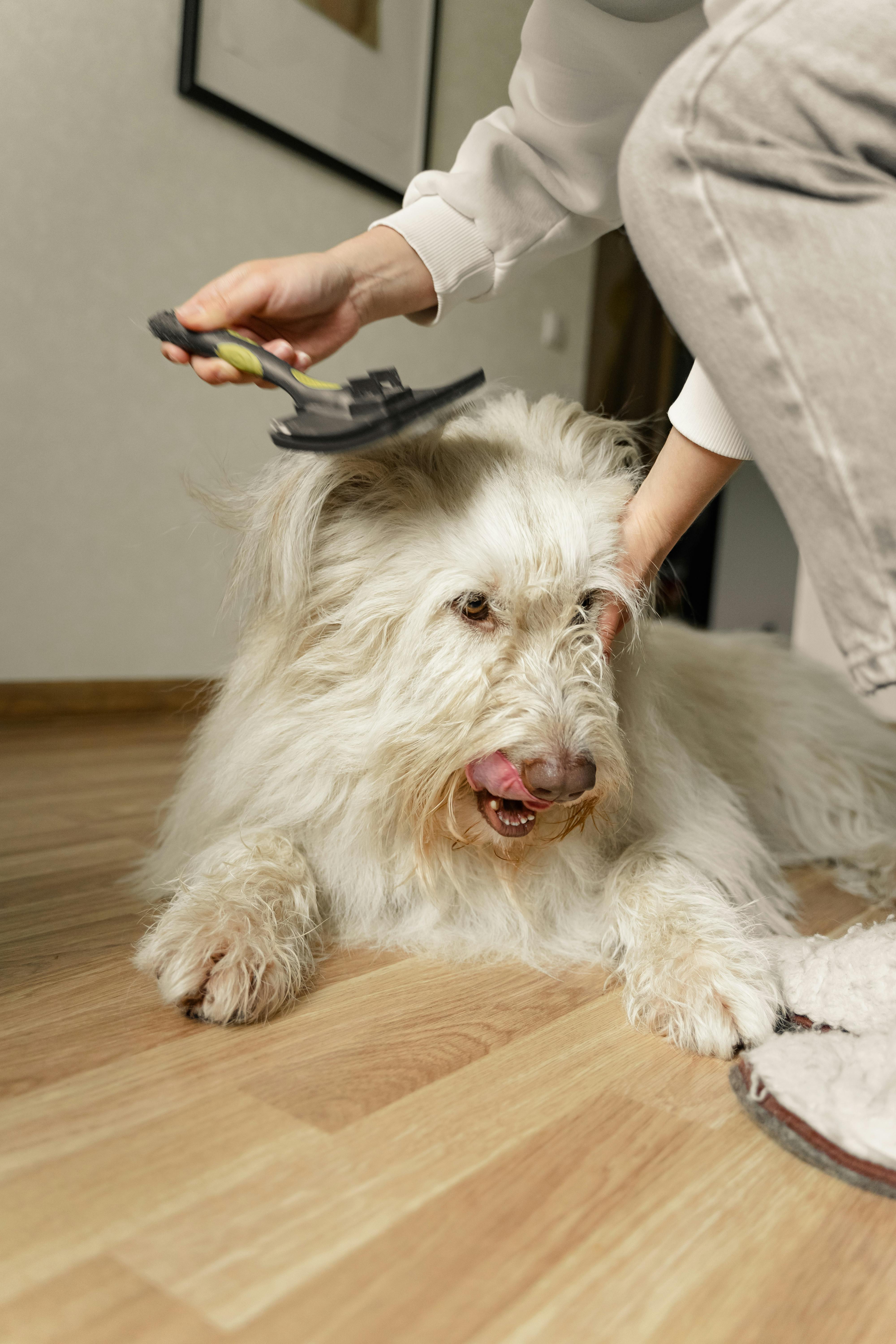
Before I get into the specific brushes, let me share something I have learned from buying and discarding a lot of grooming tools. Price does not predict performance nearly as well as the grooming brands want you to believe. What matters is whether the tool matches your dog’s coat type, whether the build quality holds up over time, and whether you will actually pick it up and use it regularly.
That last point is more important than people realize. The best brush in the world is useless if it is buried in a drawer. Features like self-cleaning mechanisms and comfortable grips are not just nice-to-haves. They are the difference between a tool that gets used three times a week and one that gathers dust. I have a drawer full of brushes I never reach for, and I can tell you that every one of them failed on at least one of those counts.
The four brushes below are the ones I keep coming back to. Each one serves a different purpose, and I will be upfront about where each falls short. No brush is perfect, and pretending otherwise does not help you make a good decision.
The Hertzko Self-Cleaning Slicker Brush: The One I Keep Within Reach
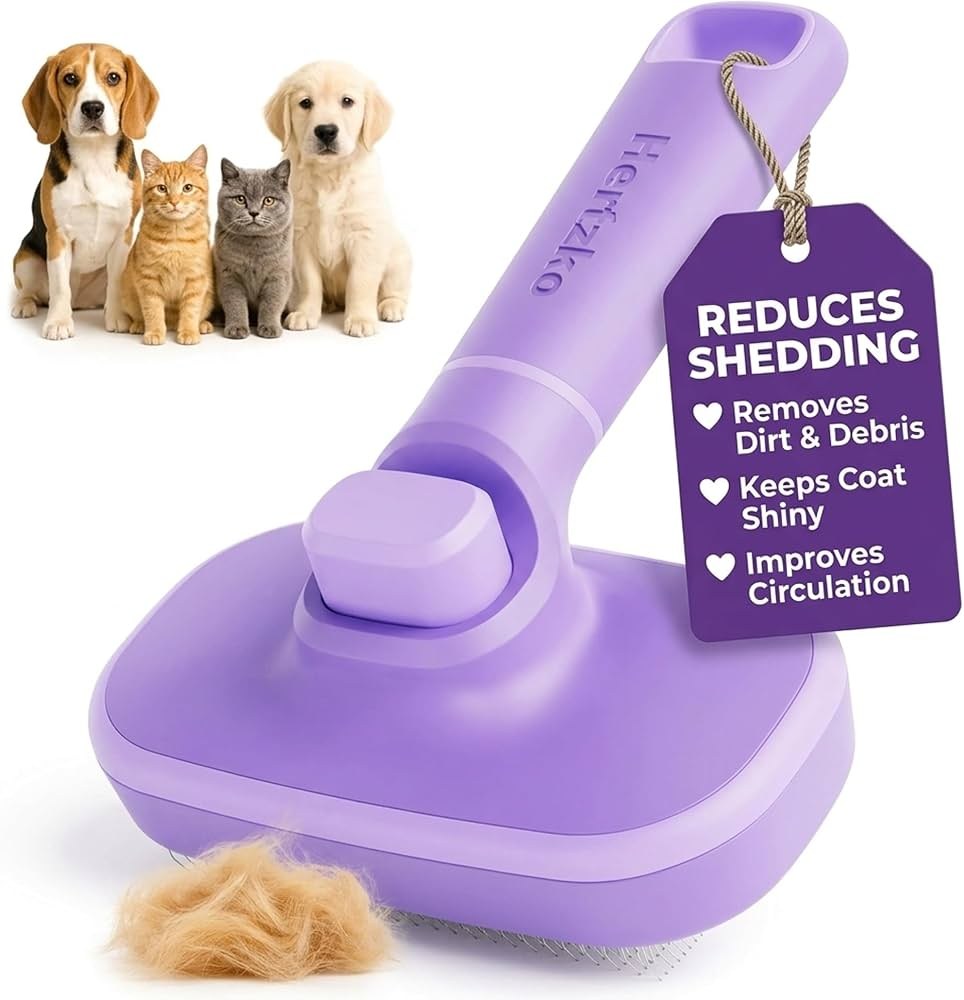
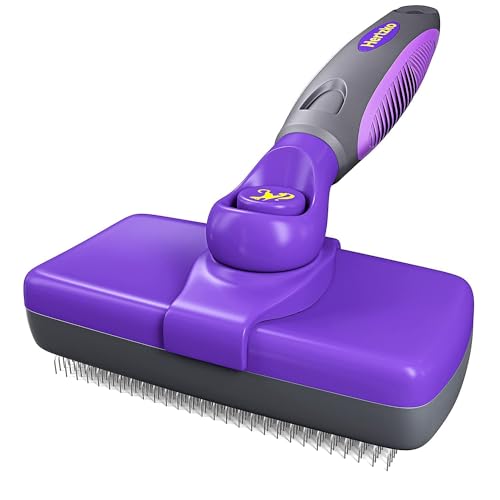
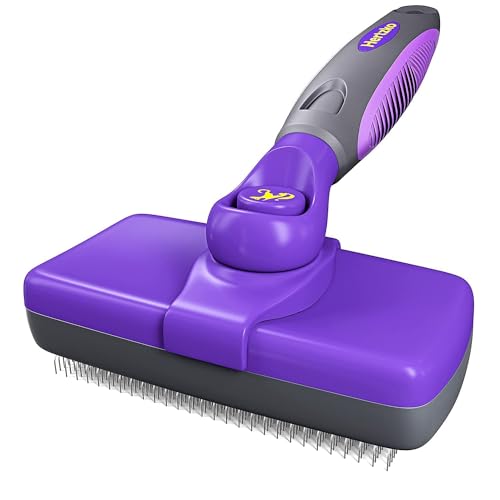
If someone asked me to recommend exactly one brush for a medium-coat dog, this is the one I would hand them. The Hertzko Self-Cleaning Slicker Brush runs about 11 to 14 dollars, and I have gone through enough expensive grooming tools to know that the price does not always predict the quality. This one punches well above its weight.
The bristles are fine wire pins, angled and tipped with a plastic coating. They glide through the coat and grab loose fur without scraping the skin. I have used this on a Cocker Spaniel and a Shih Tzu mix, and both dogs sat comfortably through sessions. The real magic, though, is the self-cleaning button. You press it and the bristles retract into the pad, pushing the collected fur off in one clean sheet. If you have ever sat there picking fur out of a slicker brush pin by pin, you understand why this feature is not a gimmick. It is the reason I actually brush my dog as often as I should, because the cleanup takes two seconds instead of five minutes.
Here is where it falls short. The brush head is small. On a German Shepherd or a Golden Retriever, you will be making a lot of passes to cover the whole coat. And while the plastic-coated tips are gentle enough for most dogs, I would be cautious using this on a dog with a very thin coat or one that is particularly skin-sensitive. The coating wears down over time, and the wire underneath is thin enough to scratch if you press too hard.
For daily maintenance on a small to medium dog, though, this brush is genuinely hard to beat at this price. I keep mine on the shelf right by the couch, and that is the highest compliment I can give a grooming tool.
Get the Hertzko Self-Cleaning Slicker Brush on Amazon
The KONG ZoomGroom: Best Eight Dollars You Will Spend on a Short-Haired Dog
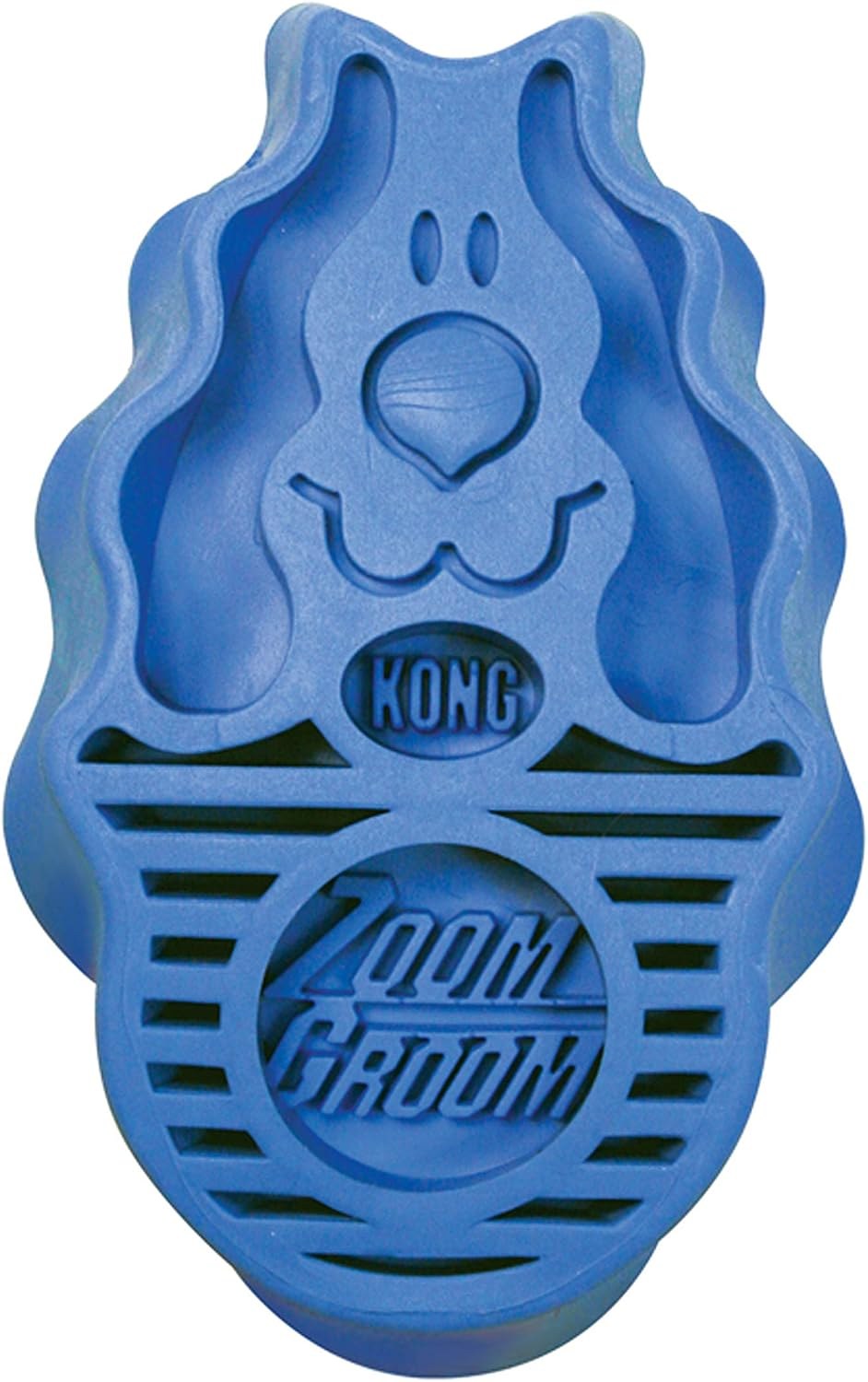
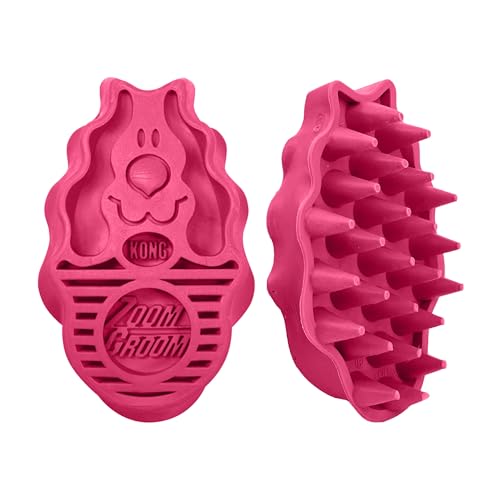
I will be honest. When I first picked up the KONG ZoomGroom, I was skeptical. It is a rubber nub brush with no handle. It looks like something you would use to scrub a pan, not groom a dog. But then I used it on a short-haired Beagle, and the amount of fur that came off was almost embarrassing. Where had all that been hiding?
The ZoomGroom works because short-haired dogs do not need wire bristles. Their fur is already short. What they need is something that grips the loose topcoat fur and lifts it away, and rubber nubs do that remarkably well. You brush in circular motions, and the rubber grabs fur that a slicker brush would glide right over. Most dogs also seem to genuinely enjoy the sensation. It feels like a massage, not a grooming session. I have seen dogs that hate wire brushes lean into the ZoomGroom and close their eyes.
The other thing I love about this brush is that it doubles as a bath tool. When you are shampooing your dog, the rubber nubs help work the soap deep into the coat while loosening even more fur than dry brushing captures. Bath day plus the ZoomGroom is a shedding reduction combo that is hard to argue with.
But let me be clear about what this brush is not. It is not for long-coated dogs. The rubber nubs are too short to reach through a dense double coat, and you will miss the undercoat fur that causes the real shedding problems. If you have a Husky or a Collie, skip this one. It also has no handle, which I find slightly awkward for longer sessions. My hand cramps after about ten minutes of circular brushing.
At 8 to 12 dollars, though, if you have a short-haired dog, this is a no-brainer. It is the cheapest brush on this list and possibly the most effective for the coat type it is designed for.
Get the KONG ZoomGroom on Amazon
The DakPets Deshedding Brush: A FURminator Alternative That Actually Holds Up
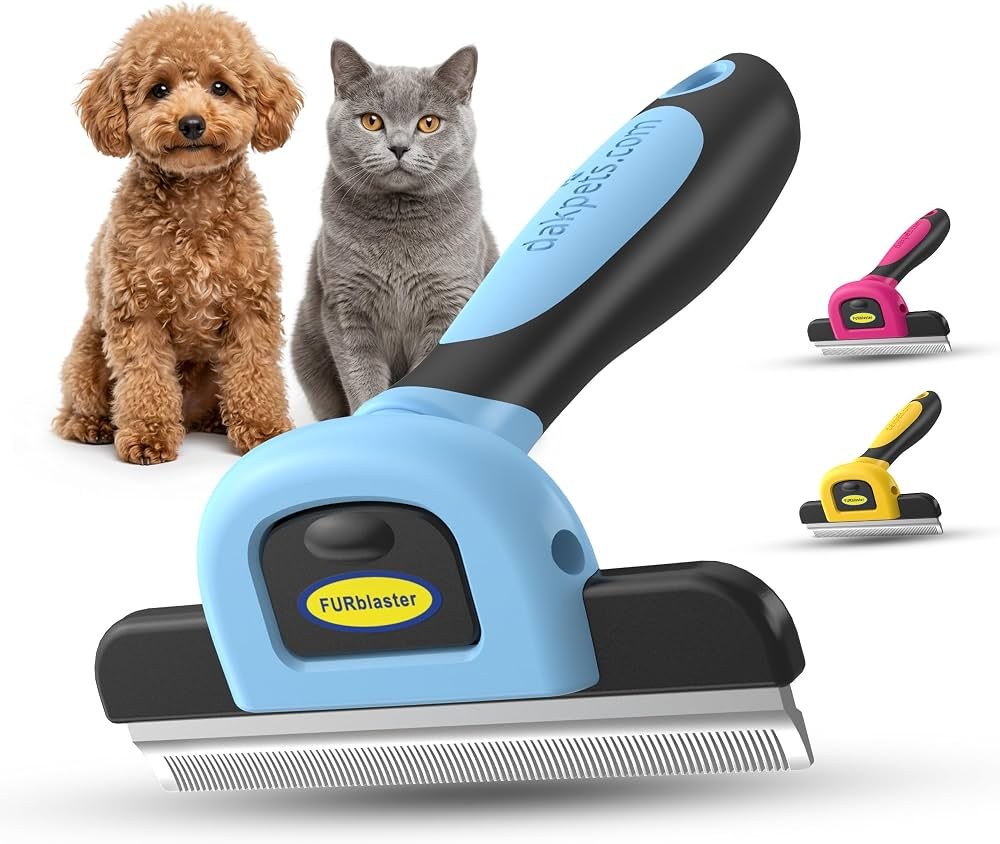
Deshedding tools are where the price gap gets ridiculous. The FURminator is the brand everyone knows, and it works, but it costs 35 to 50 dollars depending on the size. The DakPets Deshedding Brush does essentially the same thing for 14 to 18 dollars, and I have used both enough to say the performance gap is not nearly as wide as the price gap.
The DakPets uses a curved stainless steel blade with small teeth that reach through the topcoat and pull out loose undercoat fur. That is the fur that causes the real mess, the stuff that floats off your dog in clouds and settles into every corner of your house. When you use this tool on a double-coated breed during a coat blow, the fur comes off in sheets. It is almost absurd how much comes off a dog that looks perfectly clean on the surface.
The handle has a rubberized grip and a shape that fits comfortably in the hand. I have used this for twenty-minute sessions on a Siberian Husky during spring shedding season, and my hand did not cramp. The blade reaches deep enough to be effective without requiring you to press hard. Light strokes are all you need. Pressing harder does not remove more fur. It just irritates the skin, and I learned that the hard way early on.
Here is what I do not love. There is no self-cleaning mechanism. You pull the fur off the blade manually, which is not a huge deal but slows things down when you are dealing with a heavy shedder who produces a softball-sized wad of fur every few minutes. The blade also dulls over time. After about a year of heavy use on two large dogs, I noticed it was not grabbing as efficiently. At this price, replacing it is still cheaper than one grooming session, but it is something to be aware of.
If you have a heavy shedder, especially a double-coated breed, this is the tool I would recommend first from this list. It handles the volume of fur that the other brushes simply cannot reach.
Get the DakPets Deshedding Brush on Amazon
The Maxpower Planet Double-Sided Brush: Two Tools in One, With One Catch
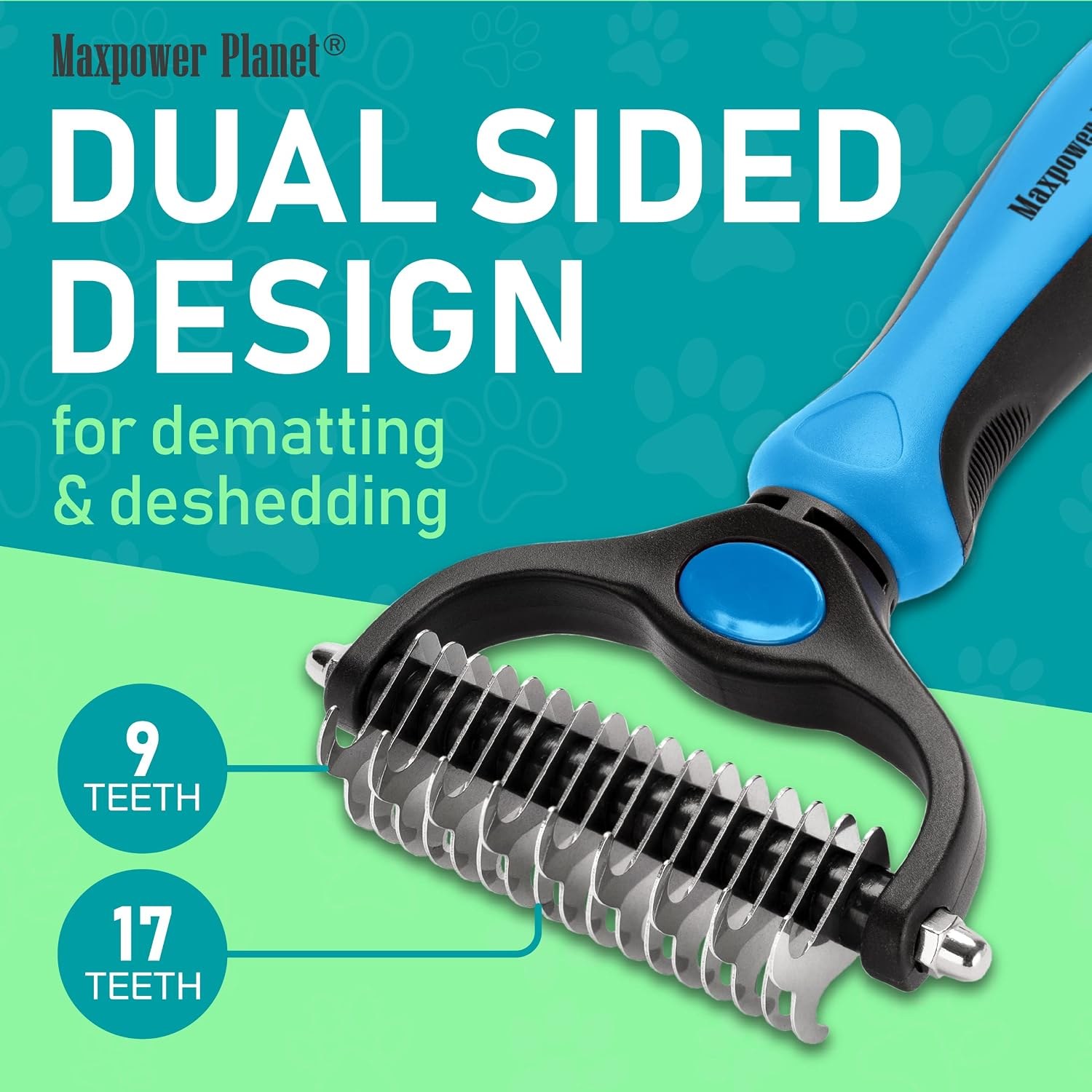
This is the brush I recommend when someone tells me their dog gets mats behind the ears or under the legs and they cannot justify buying three separate tools. The Maxpower Planet Double-Sided Brush gives you a 9-tooth undercoat rake on one side and a 17-tooth thinner on the other, all for about 12 to 16 dollars.
The 9-tooth side is for dematting. The teeth are sharp enough to cut through tangles, and they have rounded edges so they do not gouge the skin. I have used this on a Collie with serious behind-the-ear mats, and it worked through them without having to cut them out with scissors. The 17-tooth side is for finishing and thinning. After you get the mats out, you flip the brush over and smooth the coat, pulling remaining loose fur as you go.
The versatility is the selling point. Instead of buying a dematting comb and an undercoat rake separately, you get both in one tool. For someone on a budget who has a long-haired or fluffy dog, this makes a lot of sense.
But here is the catch. The 9-tooth side requires attention. Those teeth are sharp. If you are zoning out while watching TV and rake too aggressively, you can irritate your dog’s skin. I would not hand this brush to a child or a first-time dog owner without explaining how to use it first. The brush is also heavier than the others on this list, which I noticed after a long session on a Newfoundland mix. My wrist was not happy.
Still, for the price and the versatility, it earns its spot. If your dog’s coat is a tangle magnet, this is the most cost-effective way to handle it without building a collection of individual tools.
Get the Maxpower Planet Pet Grooming Brush on Amazon
How Often You Actually Need to Brush
This is where a lot of grooming guides overcomplicate things with charts and schedules and breed-specific formulas. Here is what I have learned from actually doing it over the past couple of years.
Short-haired dogs benefit from a rubber curry brush two or three times a week. That is enough to stay ahead of the shedding. Their fur is short and dense, and a quick five-minute session pulls a surprising amount off. During spring and fall when shedding peaks, bump it to daily. A Beagle or a Boxer will let you know when the shedding gets heavy because you will see fur on everything you own.
Medium-coat dogs like Golden Retrievers and Australian Shepherds need a slicker brush three to four times a week for general maintenance, plus a deshedding tool session once a week to pull undercoat fur. During seasonal coat blows, increase the deshedding sessions to two or three times a week. You will know it is time when you start finding fur tumbleweeds rolling across your kitchen floor.
Long-haired and double-coated dogs need daily attention. There is no shortcut here. During a coat blow, you are brushing every day with a deshedding tool, and there is no way around it. I spent a spring trying to skip days with a Husky, and by the end of the week the fur was so embedded in the couch that I had to use a rubber glove to pull it out. Daily brushing is the only real solution during those intense periods.
Curly-coated dogs like Poodles and Doodles shed less than other types, but their fur mats easily. Brush every day or two with a slicker brush, working in small sections from the skin outward. Pay attention to the friction zones: behind the ears, under the collar, the armpits, and the base of the tail. That is where mats form first.
The brush you buy does not matter if it sits in a drawer. A 12 dollar brush used three times a week will keep your house significantly cleaner than a 50 dollar brush you never pick up. Build the habit first. Worry about upgrading the tool later.
A Few Things Beyond Brushing That Actually Help
I am not going to give you a ten-section guide on dog diet and vacuum recommendations. But I will share a few things I have learned the hard way.
First, diet matters more than any brush. When I switched my dog from the cheapest grocery store food to a mid-tier brand with a named animal protein as the first ingredient and salmon oil in the formula, the difference in coat quality was visible within a month. Less shedding, shinier fur, healthier skin. You do not need the most expensive food on the shelf. Moving up from the absolute cheapest option pays off in ways you can see on your couch. Look for a food with a real protein source first, healthy fats, and no unnamed meat by-products. That single upgrade does more for shedding than any tool.
If your current food does not include omega-3 and omega-6 fatty acids, you can add a small amount of fish oil to your dog’s meals. A bottle of dog-safe salmon oil runs about 15 to 20 dollars and lasts for months. It is one of the most cost-effective coat supplements I have found, and the difference it makes in coat shine and shedding reduction is noticeable within a few weeks.
Second, a rubber curry brush during bath time is a cheat code. The warm water loosens the undercoat, and the rubber nubs pull it out in quantities that will shock you. If you are already bathing your dog every four to six weeks, adding a ZoomGroom to that routine doubles the fur you remove. Use a dog-specific shampoo, not whatever is in your shower. The pH is different, and human products dry out dog skin, which can actually make shedding worse.
Third, and this is not really about shedding but it matters: make brushing something your dog enjoys. If your dog runs when they see the brush, you will not do it often enough. Start slow. Let them sniff the brush. Give a treat. Brush for two minutes and stop. Over time, most dogs learn to tolerate or even enjoy it, especially if it is paired with attention and rewards. A dog that likes being brushed is a dog that gets brushed more often, and a dog that gets brushed more often is a dog that sheds less onto your furniture.
For ideas on rewarding your dog after grooming sessions, I put together a list of budget dog treats under 10 dollars that dogs actually love. A treat after brushing turns it from a chore into something your dog looks forward to. And if your dog needs to burn off energy before sitting still for a grooming session, check out my roundup of budget dog toys under 15 dollars that actually last.
Not a Prime member yet? Get FREE 2-day shipping on millions of items. Start your 30-day Prime free trial
Which One Should You Buy?
I am going to make this simple because I have spent too many hours reading Amazon reviews and testing these things myself.
Short-haired dog? Get the KONG ZoomGroom. It costs less than a fast food meal and works better than anything else for that coat type.
Medium-coat dog and you want one brush for daily use? Get the Hertzko Self-Cleaning Slicker Brush. The push-button cleaning is the feature that will make you actually use it.
Heavy shedder with a double coat? Get the DakPets Deshedding Brush. It is the closest thing to a FURminator at half the price, and during coat blow season, it will save your sanity.
Long-haired dog that gets mats? Get the Maxpower Planet Double-Sided Brush. Two tools in one, and the price makes it an easy call.
Plenty of owners end up with two brushes. A slicker or curry brush for quick daily passes and a deshedding tool for the heavy shedding weeks. Even buying two from this list keeps you under 30 dollars total, which is less than a single professional grooming session. That math is hard to argue with.
Pick the one that fits your dog. Use it consistently. Your furniture will thank you.
ThriftyPaw is reader-supported. As an Amazon Associate, I earn from qualifying purchases. This means I may earn a small commission when you buy through links on this page at no additional cost to you. I only recommend products I genuinely believe offer good value for budget-conscious pet owners.
My take: The DakPets at $14-18 does the FURminator’s job at a third the price, and the $8 ZoomGroom is the short-haired answer. The habit is the purchase: brush 2-3x weekly, add the salmon oil, and most of the couch-fur problem never makes it to the couch.
Related guides
- I Trimmed My 75-Pound Dog's Nails at Home and Only Drew Blood Twice. Here Is What I Learned.
- DIY Dog Grooming: What You Can Do at Home vs. What to Leave to the Pros (2026)
- Fall Dog Grooming on a Budget: Complete DIY Guide for 25 Dollars
- Best Budget Dog Shampoos That Actually Work (2026)
- My Golden Sheds Enough to Build a Second Dog Every Week. These 3 Supplements Actually Reduced It
🐾 Get Your Free Big Dog First Aid Kit Checklist
Join our newsletter and get this free printable plus weekly tips.
Frequently Asked Questions
What deshedding brush actually works?
The tested four under $20: the Hertzko Self-Cleaning Slicker at $11-14 (the daily within-reach pick), the KONG ZoomGroom at $8-12 (the short-haired no-brainer — 'the best eight dollars you'll spend'), the DakPets deshedding brush at $14-18 (the FURminator alternative at a third of the price — 'the performance gap is not nearly as wide as the price gap'), and the Maxpower Planet double-sided at $12-16 (undercoat rake plus thinner, two tools in one).
Is the FURminator worth the money?
Not at $35-50 versus the DakPets at $14-18 doing essentially the same job — the author used both extensively. The FURminator is the category name, but the brush-captures-hair-at-the-source physics doesn't require the brand price. The honest spend elsewhere: the $15-20 salmon oil that reduces shedding from the inside.
How often should I brush my dog?
2-3 times a week minimum during shedding season, daily during the coat-blow — the author's rule is that a $12 brush used three times a week beats a $50 brush never picked up. The consistency is the product; the tool tier just makes the habit easier to keep.
Liked this guide? Get the next one in your inbox — the pet budget checklist is free too.
✓ You're in — check your inbox.
No spam. Unsubscribe anytime. We never share your email.
Price Check
Prices verified via our product tracker. Updated Oct 5.
| Hertzko Self Cleaning Slicker Brush | $16.95 | |
| Pet Shedding Tools : Amazon.com: DakPets Dog Brush for She | $50.00 | 4.5★ (53,992) |
| Maxpower Planet Pet Grooming Brush - Double Sided Undercoa | $13.99 | 4.4★ (474) |
As an Amazon Associate we earn from qualifying purchases.