This article contains affiliate links. We may earn a commission from qualifying purchases.
Some content on this site is AI-assisted and reviewed by our editorial team.
The first time I trimmed my dog’s nails, I cut the quick on three out of eighteen nails. Blood on the floor, blood on my pants, my dog looking at me like I had betrayed her trust. I felt terrible. I paid 25 dollars a month at the groomer for the next year because I was too scared to try again.
But 300 dollars a year for nail trims adds up, and my groomer moved away last spring. So I decided to learn properly. I watched videos, practiced on my dog’s dark nails (the hardest kind — you can’t see the quick), and bought the right tools. Six months later, I trim her nails every two weeks without incident. Here’s what I learned, what I bought, and what I’d do differently if I were starting over.
Why Nail Trimming Actually Matters
Long nails aren’t just an aesthetic problem. When a dog’s nails touch the ground, the nail pushes back into the nail bed, forcing the toe upward. Over time, this changes the angle of the foot, which strains the joints and can cause chronic pain. My vet said she sees arthritic dogs whose joint pain is worsened — sometimes primarily caused — by neglected nails.
If you hear clicking on hard floors, the nails are too long. The nail should barely clear the ground when your dog is standing. For my Golden Retriever, that means trimming every 2 to 3 weeks. Dogs who walk on concrete naturally file their nails shorter and need less frequent trims. My dog walks on grass and trails, so she gets no natural filing.
Resco Guillotine Clippers — The Tool I Wish I’d Started With
Resco Guillotine Clippers are what groomers use. They have a guillotine-style blade that you slide over the nail, then squeeze to make a clean cut. The advantage over scissor-style clippers: the cutting action is smoother and more precise, which means less crushing of the nail and less chance of hitting the quick.
For dark nails — where you can’t see the pink quick inside — the guillotine design lets you take tiny slices off the tip. You cut a paper-thin slice, look at the cross-section, and stop when you see a dark dot in the center (that’s the start of the quick). This method takes longer but is far safer than guessing.
The Resco costs about 18 dollars and has replaceable blades, so when the blade gets dull (every 6 to 12 months), you swap it for a new one instead of buying new clippers. Replacement blades are 6 dollars for a pack of two.
My take: The best clippers for dogs with dark nails. The precision is worth the learning curve. I wish I’d started with these instead of cheap scissor clippers from the pet store.
Casfuy Dog Nail Grinder — The Safest Option, But Slow
The Casfuy Nail Grinder is a rotary tool (like a Dremel) that files the nail down instead of cutting. The advantage: it’s nearly impossible to hit the quick because you’re grinding, not clipping. You remove material gradually and stop before you get close to the quick.
The disadvantage: it’s slow. Trimming 18 nails with a grinder takes 20 to 30 minutes. With clippers, it takes 5 minutes. My dog also doesn’t love the sound — the buzzing makes her anxious, even on the low speed. Some dogs don’t care; mine definitely does.
What I do now: use clippers for the bulk of the trim, then use the grinder to smooth the rough edges. Best of both worlds — fast like clippers, safe and smooth like grinding.
The Casfuy costs about 26 dollars and is rechargeable via USB. The grinding bands need replacing every few months (they come with 6, and replacements are 8 dollars for a pack of 20).
My take: If you’re terrified of hitting the quick, get a grinder and skip clippers entirely. It’s slower, but you won’t draw blood. If you’re comfortable with clippers, use this as a finishing tool for smooth edges.
Scissor-Style Clippers — What I Started With, What I’d Skip
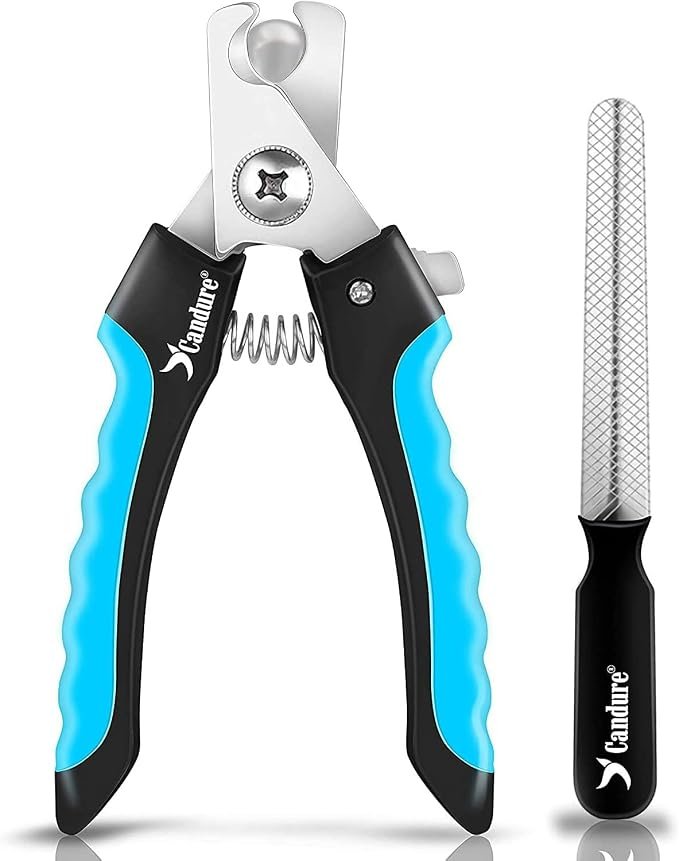
These scissor-style clippers are what I bought first — the kind you see at every pet store. They work, and they’re cheap (about 12 dollars), but the cutting action is less precise than the guillotine style. The blades tend to crush rather than slice, especially on thick large-breed nails, which leaves a rough edge and increases the risk of splitting.
I used these for a year. They’re not bad. They’re just not as good as the Resco. If you already own a pair and you’re comfortable with them, keep using them. If you’re buying new, spend the extra 6 dollars on the Resco.
My take: Functional but not ideal. The Resco guillotine is a better tool for the same price range.
Get nail trimming tools delivered fast. Start your 30-day Prime free trial for free 2-day shipping.
How I Trim Dark Nails Without Hitting the Quick
This is the technique that changed everything for me. I have a Golden Retriever with black nails on most of her paws. You cannot see the quick through the nail. Here’s the method:
- Hold the paw firmly but gently. My dog lies on her side for this.
- Take a paper-thin slice off the tip of the nail with the guillotine clipper.
- Look at the cross-section. You’ll see a white or gray circle.
- Take another thin slice. Look again.
- Keep going until you see a small dark dot in the center of the cross-section. That dot is the start of the quick. Stop there.
- If you see a pulpy, pinkish texture, you’ve gone too far. Apply styptic powder immediately.
This method takes about 90 seconds per nail. For 18 nails, that’s 25 to 30 minutes. It sounds like a lot, but you only do it every 2 to 3 weeks. And the alternative — a bloody paw and a terrified dog — is worse.
Keep styptic powder on hand regardless. It costs 8 dollars and stops bleeding instantly if you do hit the quick. Every dog owner who trims nails should have this within arm’s reach.
The Cost Breakdown: Home vs. Groomer
Here’s what I spend now versus what I used to spend at the groomer:
- Groomer: 25 dollars per visit, every 4 weeks = 325 dollars per year
- Home: Resco clippers (18 dollars) + replacement blades (12 dollars/year) + styptic powder (8 dollars) = 38 dollars first year, 20 dollars per year after
Savings: about 300 dollars per year. That pays for a lot of dog food.
The trade-off is time. I spend 30 minutes every 2 weeks trimming nails. The groomer took 15 minutes once a month. But I save the drive, the wait, and the appointment scheduling. For me, the 300-dollar savings is worth 30 extra minutes per month.
If you’re nervous about trimming your dog’s nails, start with the grinder. You can’t hurt your dog with a grinder unless you hold it in one spot for too long (it gets hot). Once you’re comfortable with the process, add clippers for speed. And keep styptic powder nearby — knowing you can stop bleeding instantly takes the fear out of the process.
For more grooming tips, check our guide to at-home grooming on a budget and our review of dog shampoos for sensitive skin.
ThriftyPaw is reader-supported. As an Amazon Associate, I earn from qualifying purchases. That means if you buy through one of the links above, I get a small commission at no extra cost to you. I only recommend tools I’ve actually used on my own dog’s nails.
Related guides
- Fall Dog Grooming on a Budget: Complete DIY Guide for 25 Dollars
- After an 85 Dollar Groomer Visit, a 106 Dollar Kit Does the Same Job at Home.
- My Golden Sheds Enough to Build a Second Dog Every Week. These 3 Supplements Actually Reduced It
- DIY Dog Grooming: What You Can Do at Home vs. What to Leave to the Pros (2026)
- Dog Hair Everywhere? These 4 Deshedding Brushes Actually Work (And Cost Less Than You Think)
🐾 Get Your Free Big Dog First Aid Kit Checklist
Join our newsletter and get this free printable plus weekly tips.
Frequently Asked Questions
Is it worth trimming dog nails at home?
The author's math: $325 a year at the groomer versus the $18 clippers plus $6 blades twice a year — the $300 annual savings for 30 minutes a month. The learning curve is real (three quicks on the first attempt), but the tool choice and the dark-nail technique are the difference between the horror story and the routine.
What's the best tool for trimming dog nails?
The Resco guillotine clippers at $18 with replaceable blades ($6 for two, swapped every 6-12 months) — the tool the author wishes they'd started with, the cleanest cutting action for dark nails. The Casfuy grinder at $26 is the safest option (USB rechargeable, no quick-cut risk, slower), and the $12 scissor-style is the cheap version with less precision — 'spend the extra $6 on the Resco.'
How do I trim dark nails without hitting the quick?
The technique that ended the blood-on-the-floor era: trim tiny slices at a time, checking the cut surface — white ring is safe, the dark dot appearing means the quick is close. The $8 styptic powder stops any mistake instantly. The grinder alternative eliminates the risk entirely for the nervous beginner, which is what the author recommends most people start with.
Liked this guide? Get the next one in your inbox — the pet budget checklist is free too.
✓ You're in — check your inbox.
No spam. Unsubscribe anytime. We never share your email.
Price Check
Prices verified via our product tracker. Updated Sep 27.
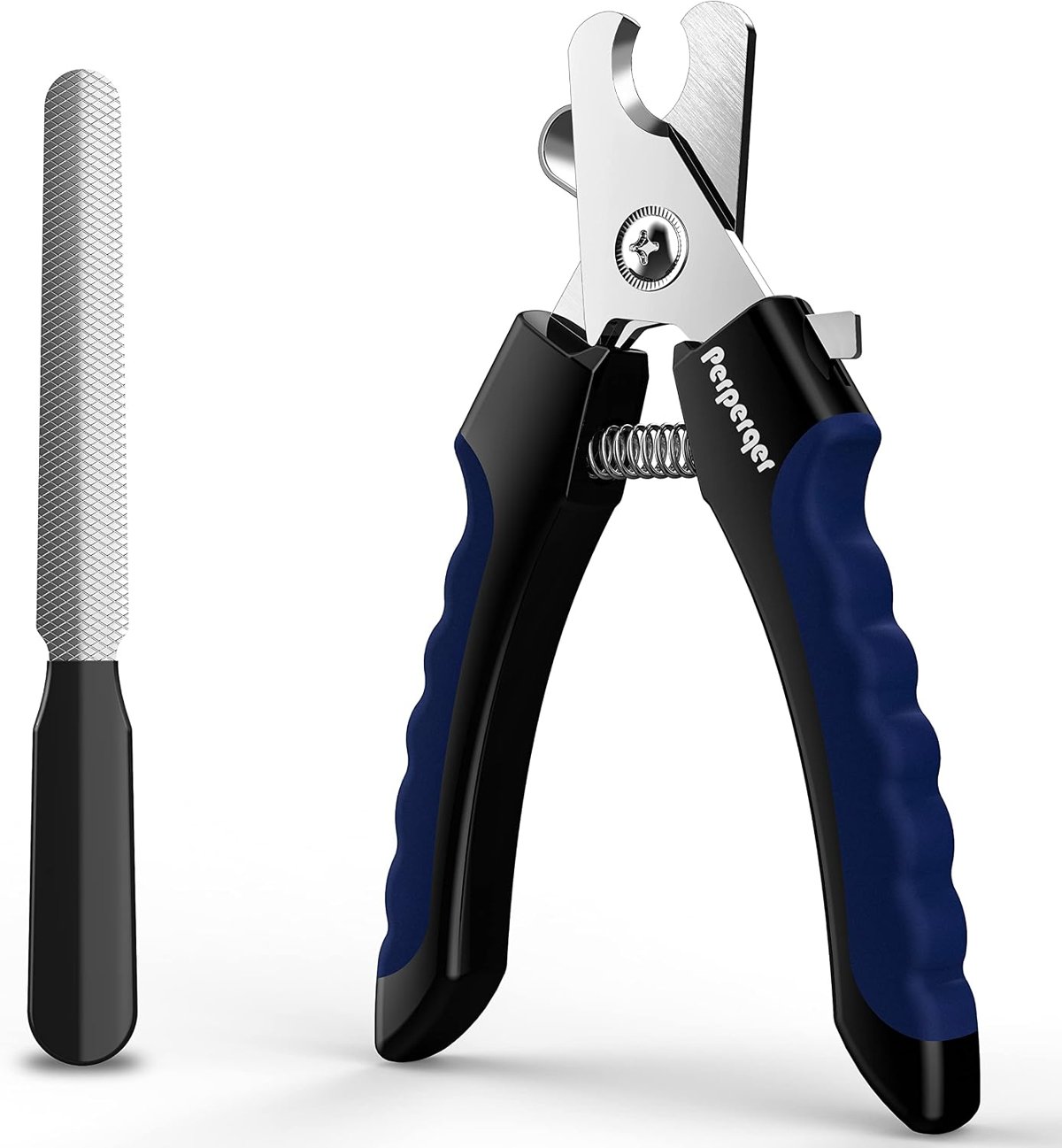
| Perperqer Dog Nail Clippers,Dog Nail Trimmers with Safety | $7.99 | 4.5★ (1,849) |
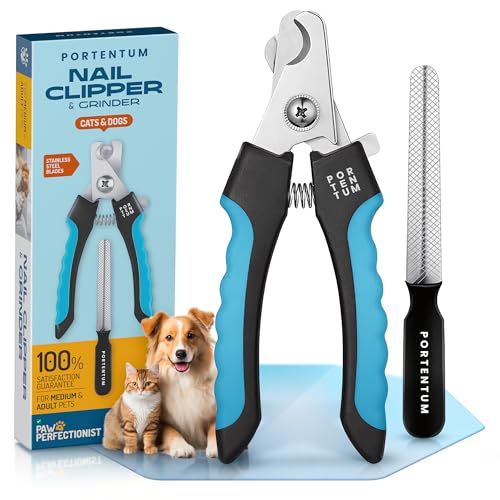
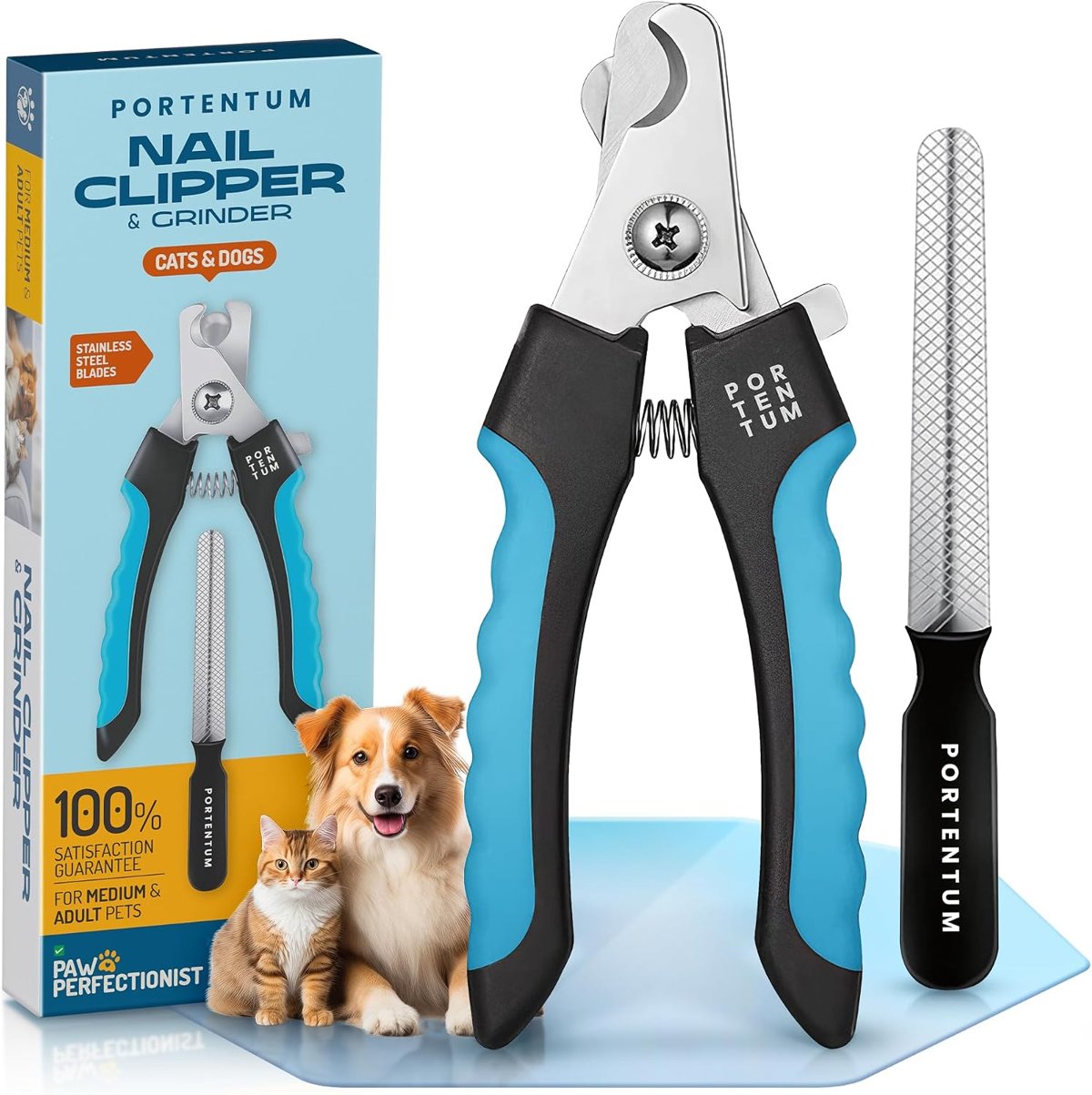
| PORTENTUM Dog Nail Clippers for Large and Medium Breed (6" | $23.06 | 4.6★ (1,436) |
| Candure Dog Nail Clippers and Trimmer with Safety Guard to | $7.49 | 4.6★ (43,307) |
| Tpotato Dog Nail Clippers,Dog Nail Trimmers for Large Bree | $7.99 | 4.6★ (11,560) |
As an Amazon Associate we earn from qualifying purchases.