This article contains affiliate links. We may earn a commission from qualifying purchases.
Some content on this site is AI-assisted and reviewed by our editorial team.
The quote showed up the way these things always do: on a clipboard at the vet’s front desk, while my cat was still getting her temperature taken. Twenty-nine dollars a month for accident-and-illness coverage, the sheet said, and I did what I always do — asked for a week to think about it, then did the math in the parking lot. The number that decides this question is not the premium. It is the bill for the classic indoor-cat emergency: a male cat straining in the litter box and producing nothing is a same-day emergency, and unblocking him with a catheter and a two-to-four-day hospital stay runs $1,500 to $3,500-plus at an emergency hospital. PetMD’s overall range for treating a blocked cat runs $500 to $5,000.
My indoor cat’s routine year — one exam, her vaccines, parasite prevention — costs a couple hundred dollars. That part I can budget. What I cannot budget is the tail: the overnight bill that arrives once a decade and hits like a car repair. So I priced cat insurance three ways — the accident-only floor, a comprehensive policy with a $500 deductible, and the top-shelf 90-percent plan — plus the savings-account route people always suggest instead. Here is the math.
The Problem Insurance Is Actually Priced Against
Indoor cats file two kinds of claims: small routine ones — an ear infection, a dental cleaning, the cat teeth-cleaning bill that can top $900 on its own — and rare catastrophic ones. Insurance is a bad product for the first kind and a genuinely good one for the second. The whole decision is which premium you pay for how much of the catastrophic tail, and which deductible you pick to keep that premium sane.

Lemonade Pet Insurance — The Quote to Beat
Lemonade is the insurer everyone gets quoted first, and its cat pricing is the benchmark: base policies start around $10 a month, published quotes for a 1-year-old indoor cat run about $19 to $34 depending on the annual limit, and Lemonade’s own average across its cat policies sits near $27 a month. The deductible ladder runs $100, $250, $500, and $750, and the claim app is the fastest in the category — most claims file and process from a phone in minutes.
- What it does well: cheap, fast, customizable coverage with annual limits from $5,000 to $100,000.
- Honest cons: premiums climb at renewal, and like every insurer, pre-existing conditions are never covered — enroll before the first sign of trouble, not after.
My take: get this quote first; every other lane in this post gets measured against it.
Trupanion — The 90-Percent Plan
Trupanion is the expensive one, and it earns it differently: about $70 a month for a cat in 2026 quote roundups, but with 90-percent reimbursement, no annual payout cap, and a per-condition lifetime deductible you pick from $0 to $1,000. That deductible structure is the real feature — if your cat blocks once and blocks again, you never pay the deductible twice for the same condition. At network vets, Trupanion pays its share directly at checkout, so you are not fronting $3,000 and waiting on a reimbursement check.
- What it does well: the strongest coverage going — 90 percent, unlimited, direct pay at the vet.
- Honest cons: roughly double the premium of a Lemonade-class plan, and the price climbs as claims stack up.
My take: the top shelf; worth it if $70 a month is easy money, or if direct pay at checkout matters to your cash flow.
Pets Best Accident-Only — The Accident-Only Floor
The accident-only plan is the honest floor: about $10 a month for accident coverage, with deductibles from $50 to $1,000 that reset annually. In published quote comparisons, a full illness policy for a young cat runs about $35 — so the cheap plan skips the expensive half of the risk on purpose.
- What it does well: ten dollars a month is two fancy coffees, and it covers the swallowed-string class of disaster.
- Honest cons: illness is what indoor cats mostly need — the urinary blockage, the kidney diagnosis, the dental disease — and accident-only covers none of it.
My take: I would not run accident-only on a male cat, because the blockage is the exact bill it will not pay.
American Pet Supplies Pet First Aid Kit, 19-Piece — The Self-Insurance Starter
Whichever lane you pick, keep a pet first aid kit in the closet. This 19-piece travel kit covers cats and dogs both, costs about $13, and handles the small stuff a deductible never touches: the torn claw, the minor cut, the tick you find at 10 p.m.
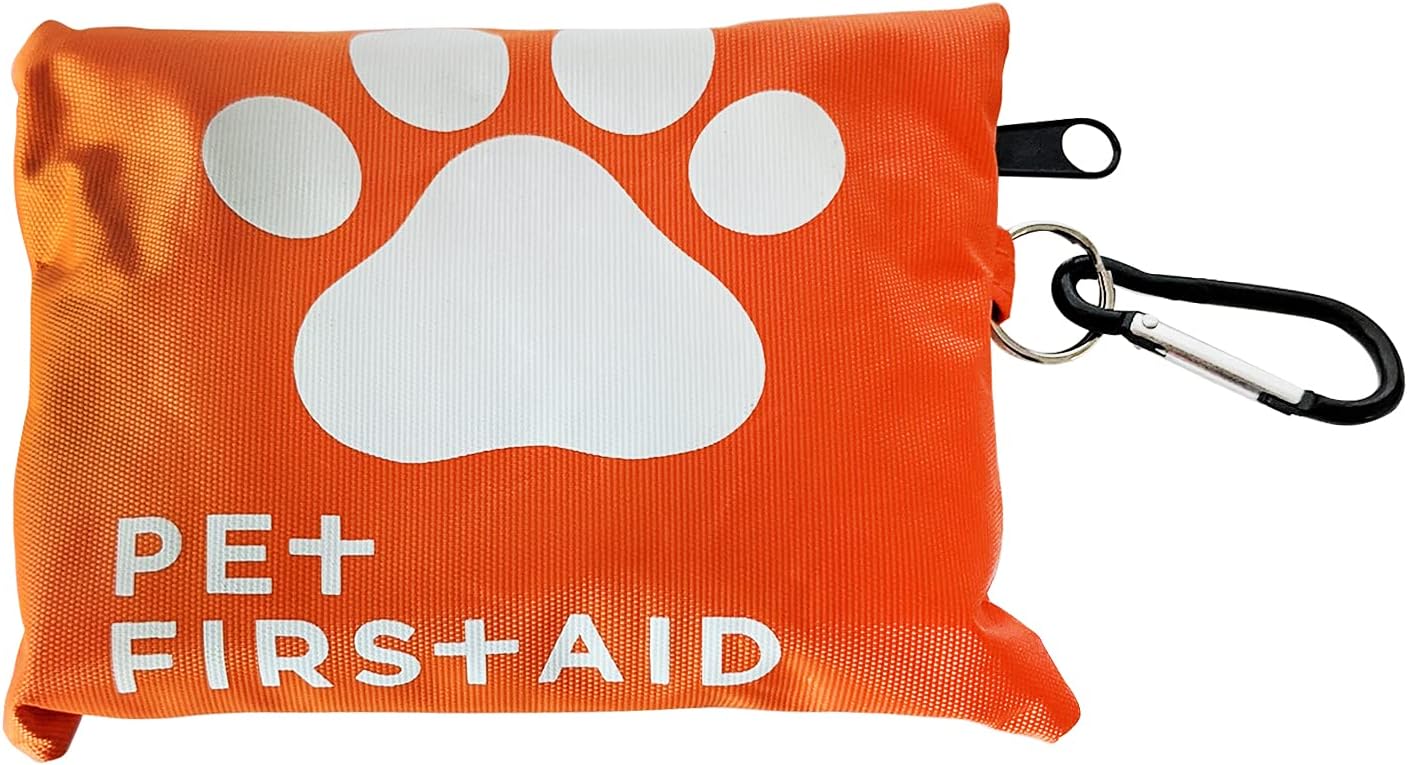
- What it does well: cheap, compact, and cat-appropriate — the stuff you reach for weekly.
- Honest cons: it is a cut-and-scrape kit, not a trauma kit; restock the gauze after any real use.
My take: buy it the same day you pick a policy; it is the only $13 in this decision that pays back immediately.
Shipping on the house stuff: a 30-day free Prime trial covers two-day shipping on the kit and any cat supplies you add to the order. (ThriftyPaw is an Amazon Associate, so purchases through that link support the site at no extra cost to you.)
Why the $500 Deductible Won for My Indoor Cat
A small deductible only earns its keep if you expect to hit it every year — and an indoor cat mostly does not. Her claims, when they come, are rare and large, which is exactly the shape that favors a higher deductible with high reimbursement. Run the arithmetic on the blockage bill: a $3,000 emergency invoice through a $500 deductible at 90-percent reimbursement means the insurer pays $2,250 and I pay $750. At 80 percent, I pay $1,000. Dropping to a $100 deductible would save me $320 to $360 on that one bill — but it costs more every month of the cat’s life, healthy or not, and the indoor cat is healthy most years. The $500 deductible keeps the premium in the $25-to-$35 range while still cutting the tail risk to pieces. That is the whole case.
The Annual Cost Comparison
- Accident-only, about $10 a month: roughly $120 a year — and you still carry the illness risk, which is the one that matters.
- Comprehensive, $500 deductible, about $25 to $35 a month: roughly $300 to $420 a year, tail risk transferred. This is the lane I signed.
- Trupanion 90-percent unlimited, about $70 a month: roughly $840 a year — the most coverage and the biggest bill.
- No policy, $25 a month into savings: $300 a year banked — until a year-one blockage leaves the fund about $2,700 short of the midpoint bill.
Features That Actually Matter (And Ones That Don’t)
- Per-condition vs annual deductible: for the cat who re-blocks, Trupanion’s lifetime per-condition deductible matters more than any headline price.
- Reimbursement percentage: 80 vs 90 percent on a $3,000 bill is a $250 swing — often bigger than a year of premium differences.
- Waiting periods: illness claims wait out the policy’s waiting period, and anything diagnosed mid-policy is pre-existing forever. Enroll while she is healthy.
- Wellness add-ons mostly don’t: the routine year is budgetable on your own; do not pay a markup to insure it.
What deductible should an indoor cat have?
Five hundred dollars, with 80-to-90-percent reimbursement and the highest annual limit you can buy cheaply. It keeps the monthly in the $25-to-$35 range and still cuts the worst indoor-cat bill from $3,000 to about $750 to $1,000 out of pocket.
Keep reading: the vet-bill math continues — the $900 cat teeth-cleaning quote and the $7-a-month routine that slows it, plus the litter box cabinet that ended our laundry-room shuffle.
ThriftyPaw is reader-supported. As an Amazon Associate, I earn from qualifying purchases. That means if you buy through one of the links above, I get a small commission at no extra cost to you. I only recommend products I’ve actually used with my own pets.
🐾 Get Your Free Big Dog First Aid Kit Checklist
Join our newsletter and get this free printable plus weekly tips.
Frequently Asked Questions
Is pet insurance worth it for an indoor cat?
It depends on the tail risk, not the routine year. An indoor cat's regular care runs a couple hundred dollars, but a urinary blockage — the classic indoor-cat emergency — runs $1,500 to $3,500-plus at an emergency hospital. A comprehensive policy with a $500 deductible costs about $25 to $35 a month and turns that bill into roughly $750 to $1,000.
What deductible should I choose for cat insurance?
For an indoor cat, $500 is usually the sweet spot. A lower deductible only wins if you expect to hit it every year, and indoor cats mostly do not — their claims are rare and large, which is exactly what a higher deductible with 80-to-90-percent reimbursement handles best.
How much does cat insurance cost per month?
Accident-only plans start near $10 a month, comprehensive coverage for a young indoor cat runs roughly $19 to $34, and top-shelf unlimited plans with 90-percent reimbursement — Trupanion's lane — run closer to $70 a month.
Does pet insurance cover a blocked cat?
A blocked urinary tract is an illness claim, so a comprehensive accident-and-illness policy covers it after the waiting period, minus your deductible and your share of the bill. Accident-only plans do not — which is the honest reason not to run one on a male cat.
Liked this guide? Get the next one in your inbox — the pet budget checklist is free too.
✓ You're in — check your inbox.
No spam. Unsubscribe anytime. We never share your email.